At a glance: a working, regularly pumped septic system generally does not need additives. No additive replaces pumping, and none fixes a failed drain field. A product may be inexpensive, but the money saving claim is weak. Pumping, inspection, water use, and repairs belong to a licensed pro.
You may see bacteria, enzyme, oxygen, or chemical bottles at a hardware store and wonder whether they help or simply make the tank feel fresher. The honest answer is that many products do not make a maintained system better, and some can push a small problem downstream.
This guide covers what septic tank additives claim to do. It also gives a plain checklist for when to skip a product and call a professional, so you do not spend money on a bottle while a tank, filter, baffle, or field waits for attention.
In this guide: what the evidence says about septic tank additives, product types, risks, and the better next steps for a maintained septic system.
What additives claim to do
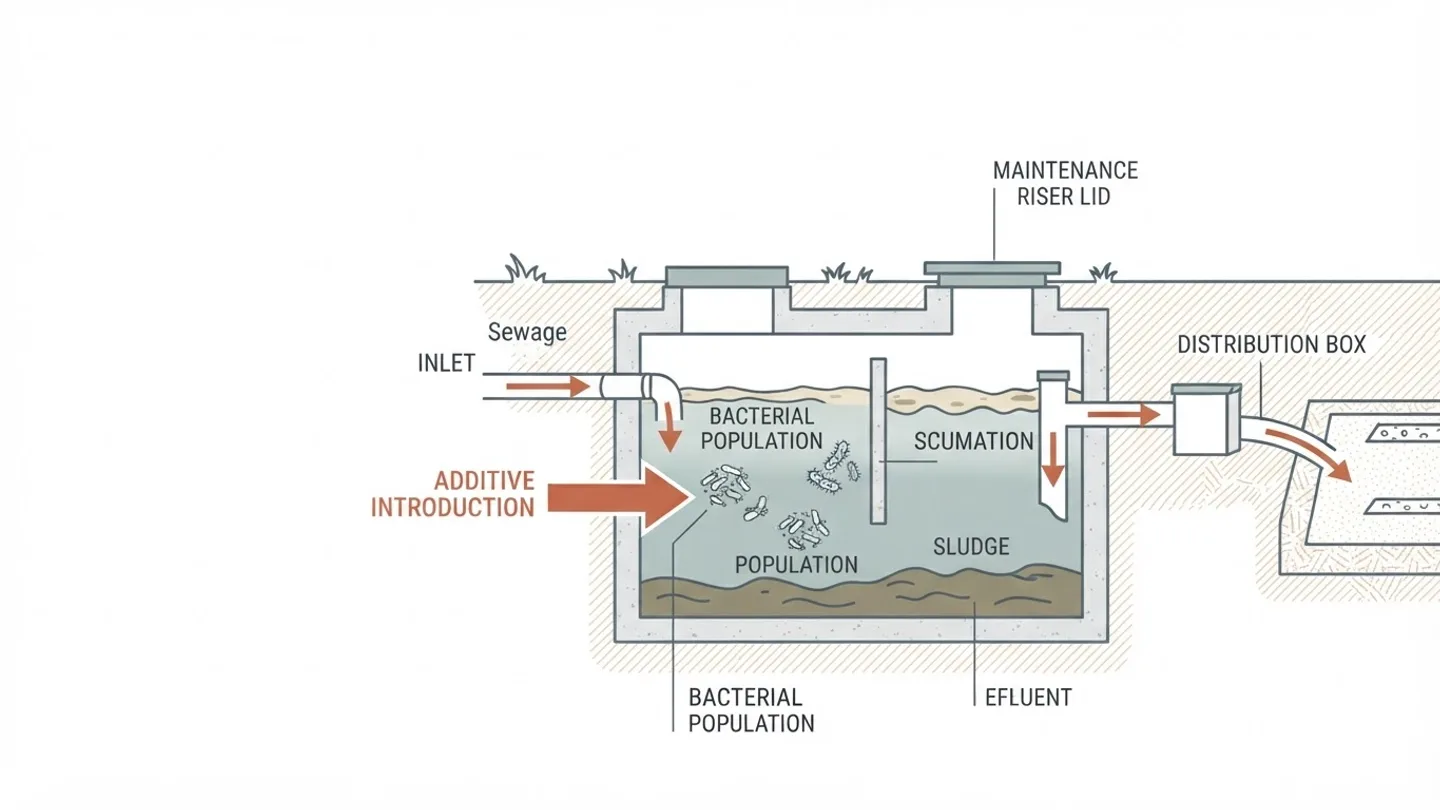
A septic tank is a quiet separator. It lets solids fall to the bottom, where they turn into sludge. Lighter material floats near the top, where it forms a scum layer. The clearer liquid between those layers, called effluent, leaves the tank through a baffle, a divider at the outlet, or a filter.
Most additives promise to act on one part of that picture. Bacteria products claim to speed sludge digestion. Enzyme products claim to break down paper, grease, or solids. Chemical products claim to cut fats or keep lines moving. Oxygen tablets claim to boost microbes in a field or aerobic chamber.
A few products also sell a broader story. They say the tank is starving, the field needs life support, or your system can go longer without pumping. That story is not the normal maintenance advice.
The tank is not an empty place waiting for good microbes. Household waste already brings microbes in. In a healthy system, a slow-growing community of bacteria and other organisms works in the dark, low-oxygen liquid.
Because the tank is already busy, adding more bacteria is usually like adding more cooks to a kitchen that already has too much work. It may not change the end result.
The better question is what is causing the trouble. Too much water at once, grease, wipes, disposal sludge, a clogged filter, or a high scum layer can create symptoms without a broken field.
| Type | What it claims | What guidance suggests | Smart use |
|---|---|---|---|
| Bacteria | Adds helpful microbes to speed sludge breakdown. | A healthy tank already has microbes. Added bacteria are not shown to replace pumping for a conventional system. | Skip unless a manufacturer or inspector recommends it for a specific system. |
| Enzyme | Digests grease, paper, and solids. | Enzymes can react in a controlled cup, but a tank is dilute, slow, and full of competing material. They are not a reliable way to cut pumping intervals. | Do not rely on them for maintenance. |
| Chemical | Cuts fats, clears drains, and keeps the field open. | Public guidance often warns against routine chemical treatments. Some products can disturb microbes, move solids or fats downstream, or damage components. | Skip. Call a pro for a blockage. |
| Oxygen | Boosts microbes, reduces odor, and helps the field. | Oxygen can be useful in some designed aerobic systems, but it is not a fix for a saturated or clogged conventional field. | Use only if the system and manufacturer allow it. |
| Household | Yeast, sugar, detergent, or soap can treat the tank. | Home remedies are not a proven part of septic care. Laundry detergent is laundry detergent, not a tank treatment. | Skip. |
What public guidance says
Public guidance for homeowners from EPA and state university extension offices is blunt on one point: a conventional septic system does not need additives as routine maintenance.
EPA materials treat a septic tank as a settling and storage chamber, not a place where store-bought treatments are required to keep things working.
Extension advice usually points to a short list: pump at intervals based on tank size and use, watch water use, keep non-household waste out, and check the system before trouble spreads.
That guidance does not recommend bacteria or enzyme products as a way to avoid pumping. Pumping is a physical removal of layers. A product can change chemistry for a short time, but it does not remove the sludge and scum that grow with household use.
Some state materials also caution that unregulated or poorly tested products may harm systems. If a label says the product replaces pumping, treat that claim as a warning sign.

Why a bottle can hide the real issue
An additive can make a symptom quiet for a while without fixing the cause. That is risky because a septic problem often moves in stages. The tank fills, the outlet slows, the field starts to struggle, and the yard shows it late.
If sludge and scum are already thick, mixing in a product may stir the tank without removing anything. Some liquids can emulsify fats, meaning they break them into smaller particles. Smaller does not always mean safer, because the particles can travel farther into the outlet or filter.
An effluent filter, a screen at the tank outlet, can trap fine grease and solids better than an open tank can. If a product pushes those fines downstream, the filter may clog, or the soil may face a harder load.
In an aerobic septic system, which uses blower air and more sensitive treatment steps, random products can cause real trouble. They can affect pumps, floats, disinfection parts, alarms, or the biological balance the unit depends on.
The biomat is another point homeowners often misunderstand. A biomat is a natural layer that forms in the soil around the field. It helps treat effluent but can also slow drainage if the system is overloaded. Additives do not rebuild a field that cannot accept water.
If you already see a wet patch, an odor near the field, or a backup, do not spend the day shopping for a miracle bottle. Check the tank first.
What works instead of routine additives
The practical version of septic care is not a monthly bottle. It is using less water at once. A big laundry run and a full house of showers can push more volume into a tank than it should settle, especially if the field is already slow.
Keep the wrong solids out of the tank. Wipes, feminine hygiene products, paper towels, grease, and disposal waste can add sludge or scum that a tank is not sized to handle. Even products labeled flushable can be trouble.
Keep harsh household chemicals out as well. Paint thinners, solvents, motor oil, and large amounts of drain cleaners are not septic tank care. They can harm microbes, pipes, or downstream components.
Pump by measurement, not by smell. A licensed pumper can measure sludge depth and scum depth at the outlet, check the baffle, and look at the effluent filter if present. Those numbers matter more than a label on a bottle.
If you are buying a home with septic, do not ask about additives first. Ask for tank size, pump records, inspection findings, water use estimates, and the field condition.
If a quote says you need a full drain field replacement, ask for the reason. Is the field truly saturated, is the tank level high, is the soil clogged, or is the system simply overloaded with water? A second opinion can save money and avoid unnecessary repair.
If you use an additive anyway, use it as an experiment, not a habit. Write down what you added, why you added it, and whether the symptom changed. That record helps a professional separate a real problem from a temporary scare.
If you see a septic problem now: a steady, practical order of operations for slow drains, odor, wet lawn spots, or backup.
Stop adding products
Do not keep pouring treatments while a tank is filling. The next step is measurement, not more chemistry.
Cut water use now
Delay laundry, limit showers, and hold off on other heavy fixtures until the system is checked.
Mark the symptom
Note where the lawn is wet, where odor is strongest, and whether indoor drains are slow. Do not dig over the field.
Check safety before touching the tank
If you know where the lid is, lift it only if it is secure and you are not alone. Never enter a septic tank. Gases inside can be dangerous.
Call a licensed pumper or inspector
Ask them to check sludge depth, scum depth, outlet level, baffles, filter, distribution box (the outlet box that splits flow to field lines) if accessible, and field conditions.
Get the plan in writing
Ask what caused the problem, what will be pumped or repaired, what will be monitored, and when to call again.
Common homeowner questions about septic tank additives and when they should not be used as a fix.
Should I put an additive in every month?
No. A working system does not need monthly treatments. If you have water, waste, or maintenance problems, add them only after a professional checks the system.
Can an enzyme product reduce pumping frequency?
No. Pumping is needed because solids build up in layers. Enzyme products are not a reliable way to make sludge disappear or to stretch pump intervals.
What if the product says it is septic safe?
A label is not proof that it helps. Ask whether it contains solvents, harsh acids, or strong surfactants, and ask your pumper or local health office before using it in a sensitive system.
What about odor tablets?
A little odor masking may help briefly, but a septic odor can come from a full tank, a vent issue, a clogged filter, or a saturated field. Look for the cause before treating it.
Can additives fix a slow drain field?
No. A slow field usually means hydraulic overload, clogged soil, or a damaged distribution box. Additives do not rebuild soil capacity.
Should I use an additive in an aerobic system?
Only if the manufacturer or a licensed inspector recommends it for that exact unit. Aerobic systems can have blowers, pumps, disinfection parts, and alarms that react badly to random products.
If a backup happens, should I dump a chemical first?
No. Stop water use, keep people away from standing wastewater, and call a licensed pro. Chemicals can create a false sense of motion while the real cause remains.

What to remember: skip additives as routine care, and use the money for a sound pump-out, inspection, and repair decision instead.
- A healthy, regularly pumped system usually does not need additives.
- Bacteria and enzyme products are not proven to replace pumping.
- Chemical and oxygen products can be risky, especially in aerobic units.
- Odors, slow drains, and wet lawn spots point to tank, filter, vent, water use, or field conditions, not a missing bottle.
- Pumping by measurement and inspection by a licensed pro are better uses of money than routine treatments.
Leave a Reply