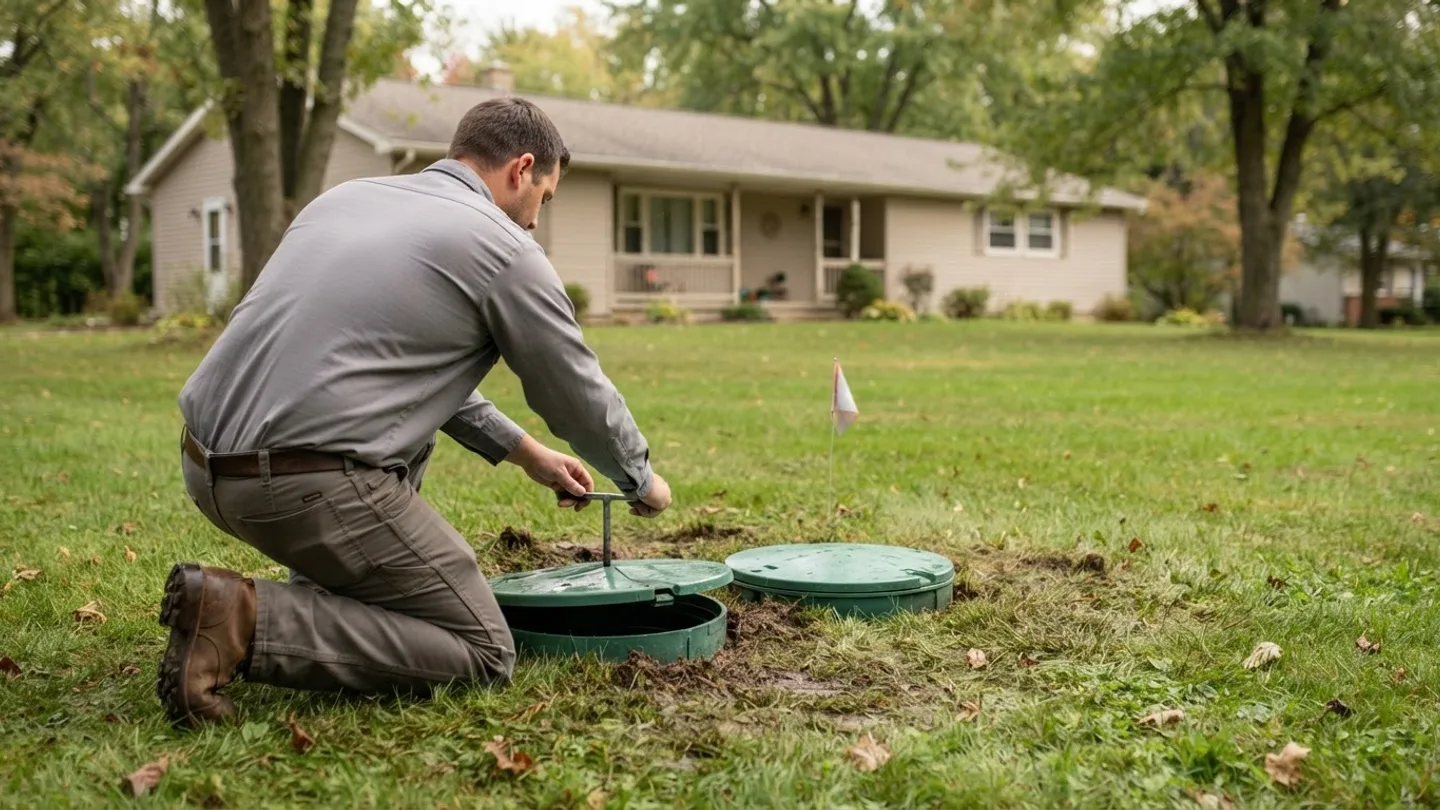
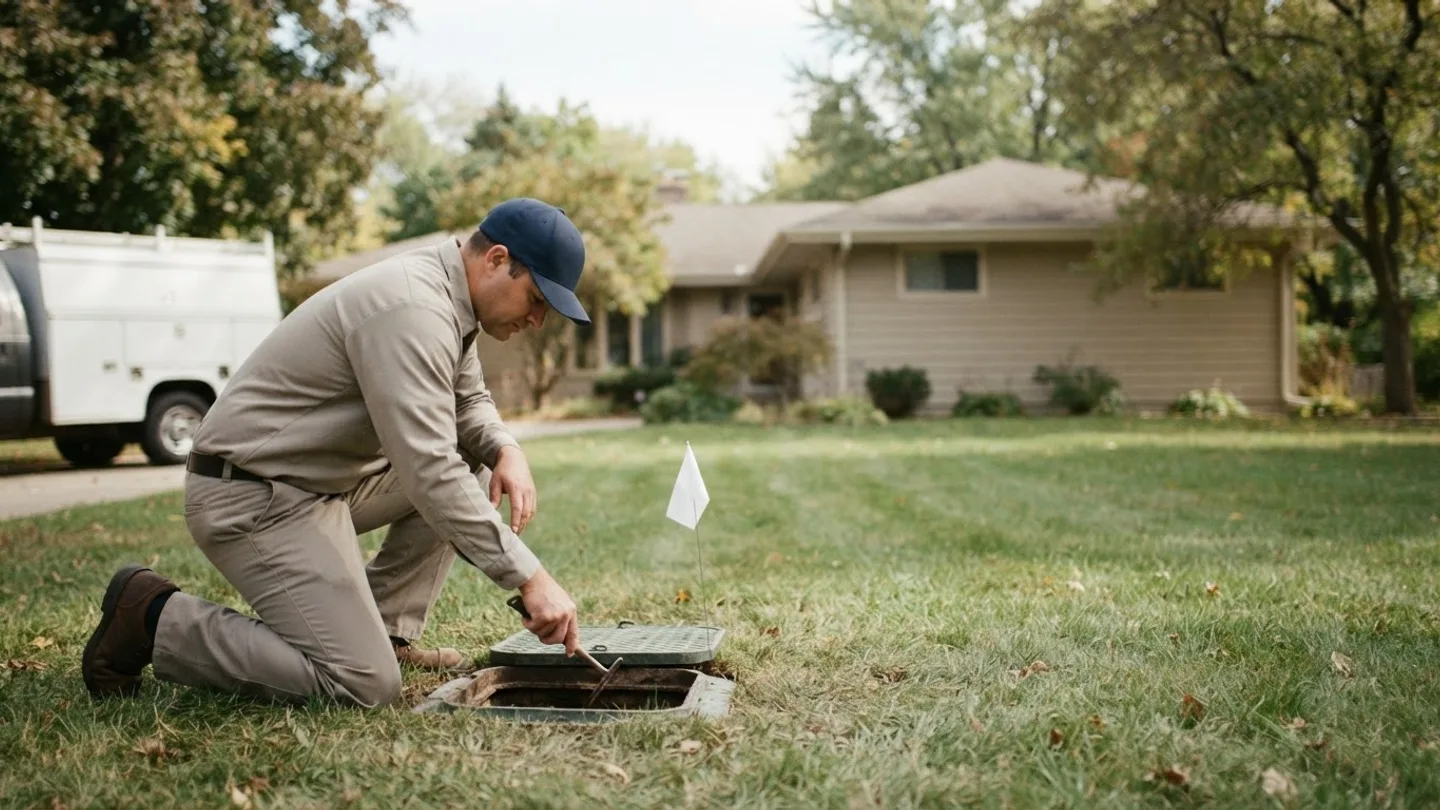
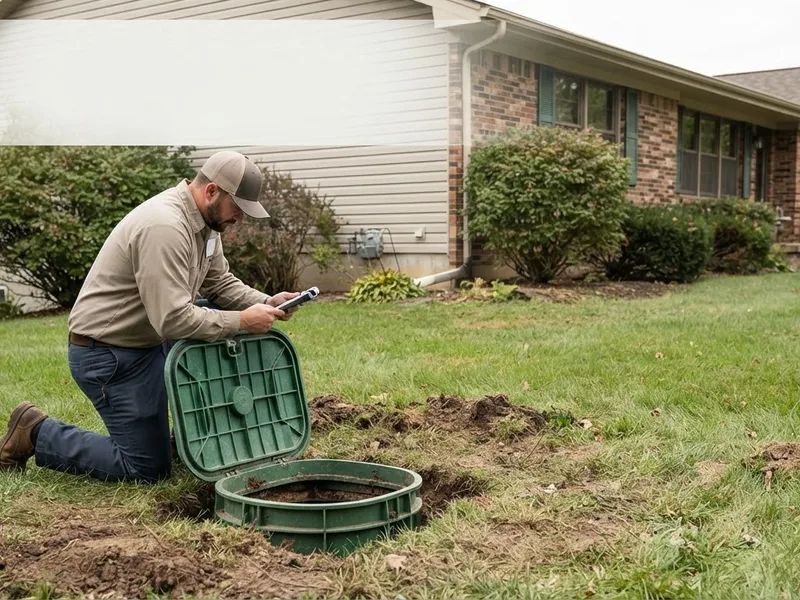
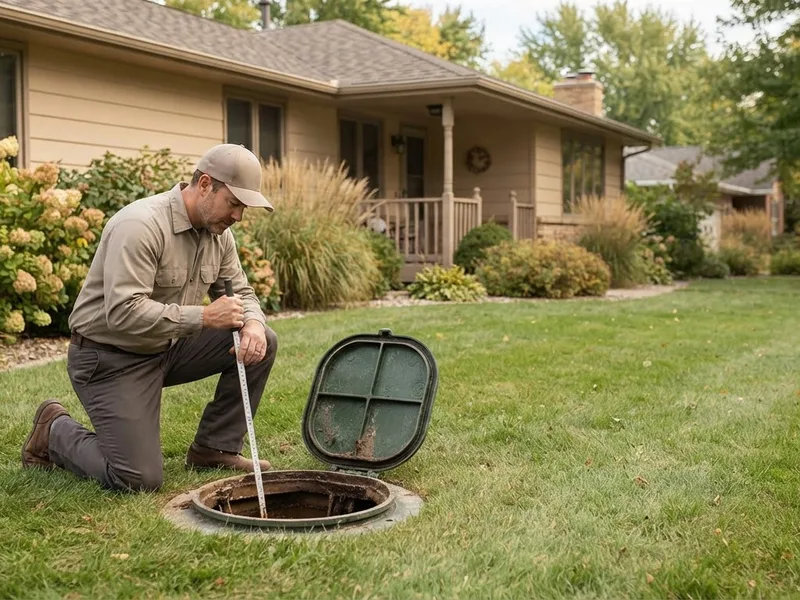
If your sink is slow, the toilet gurgles when the washing machine runs, or grass over the drain field is greener than the rest of the yard, your septic tank may be moving toward a pump. If wastewater is backing up into a tub, shower or floor drain, stop running fixtures, keep people out of the wet area and call a septic pumper before the problem gets bigger.
Most people hear that a tank is full and picture a glass filled to the rim. A septic tank works differently. It always holds liquid while it is doing its job, and the issue is not usually the water. The issue is the solid layers that build up at the top and bottom.
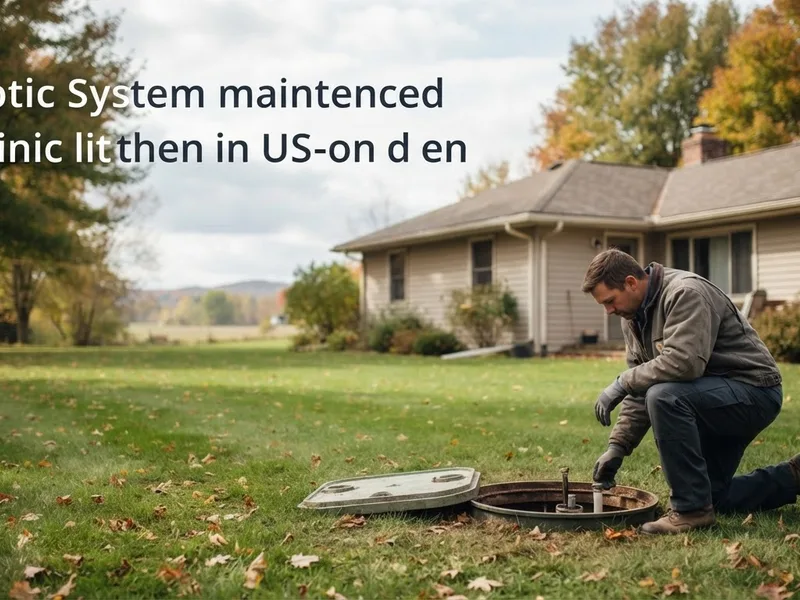
This page answers how to tell if your septic tank is full, why that phrase can mislead, what signs matter most and how a pumper checks the scum layer and sludge before recommending pumping.
Drains slow down, then a toilet, tub or basement shower starts backing up. That usually means your septic system backed up, and the first step is to stop feeding it with water.
You do not need to know the exact cause in the next ten minutes. You need to prevent more drainage from reaching a tank, a plugged pipe or a saturated drain field.
Stay steady, keep the household away from wet areas and call a qualified pumper. The next sections explain what to do, what the pumper will check and what usually affects the cost.
Stop adding water. No showers, toilets, laundry, dishwasher or hoses until help arrives.
Keep kids, pets and visitors away from wet ground, standing water or areas that smell near the tank or drain field.
Do not open the tank lid. Gases and pressure can cause injury.
Call a qualified or licensed septic pumper, or a plumber if only one fixture is affected and you suspect a house line blockage.
Ask for written next steps after the pump truck leaves, not just a verbal pump it and see answer.
What to do in the next hour
Stop the water input
Do not run faucets, shower, flush, load the washing machine or start the dishwasher. If you have a water softener, filter or hose feeding into the septic side, turn it off or bypass it if that is simple.
Do not keep resetting pumps or alarms
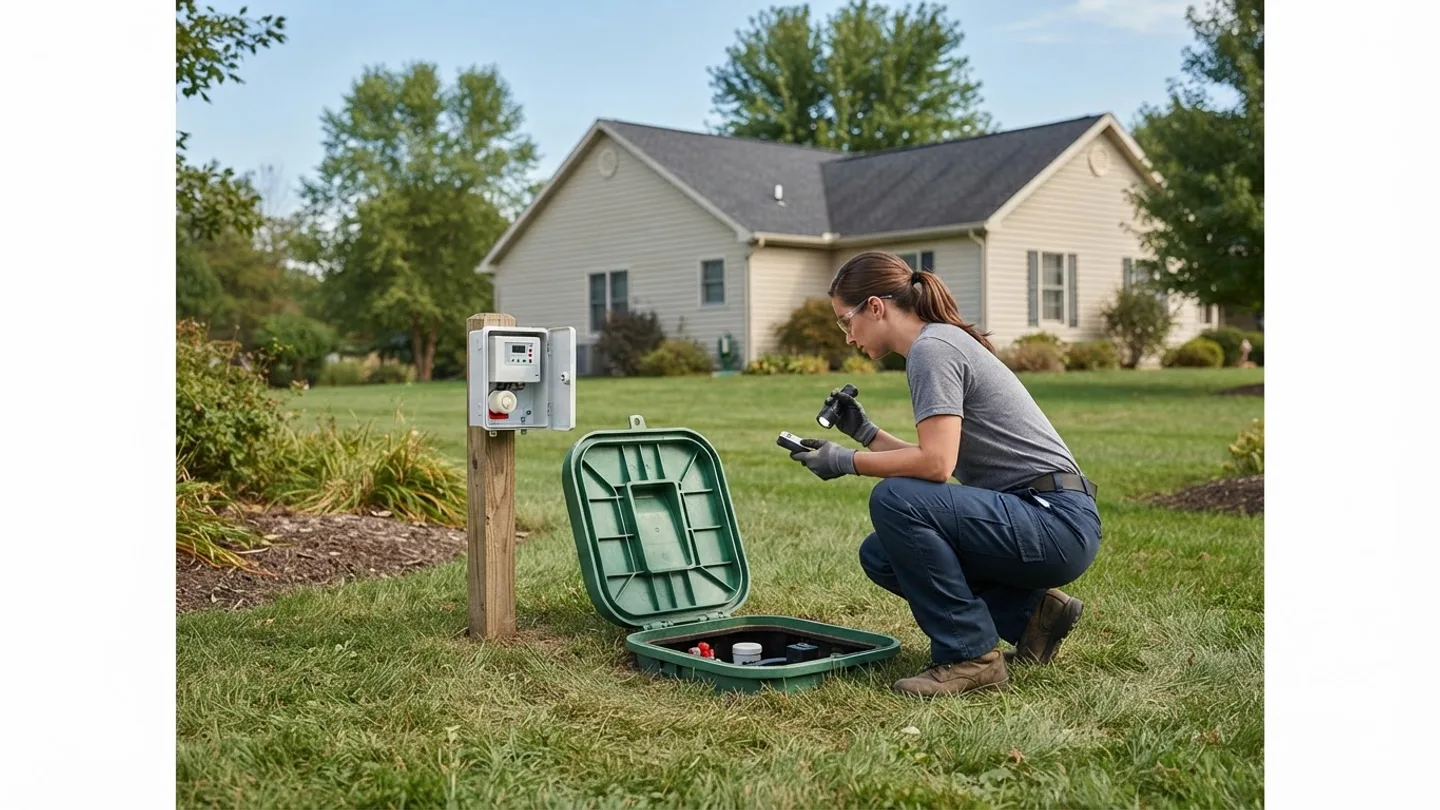
If your system uses a pump, blower or alarm, note what fixture was running when the trouble started. Do not keep resetting equipment. If the owner manual gives an emergency stop step, use it. If not, wait for a pumper or plumber.
Keep people and pets clear
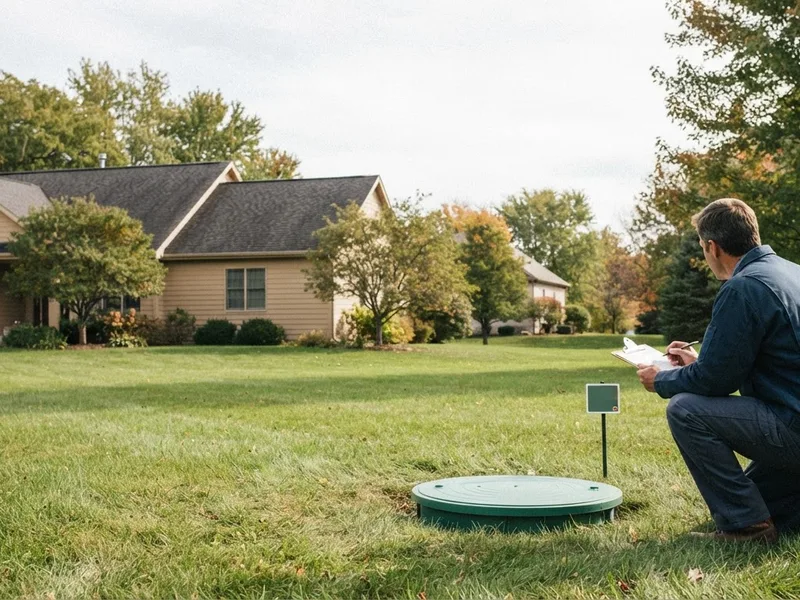
Stay several feet back from tank lids, inspection ports, vent pipes, wet soil and any standing water. If a lid is buried, do not dig. Mark the area if you can do so safely.
Do not open the tank
Septic tanks are confined spaces. They can have low oxygen and harmful gases. A person at the open lid can become dizzy, slip or fall in.
Call the right help
Call a septic pumper first when multiple drains back up, the yard smells, the ground is wet over the tank or field, or drainage enters the house. Tell them you think your septic system backed up, what fixtures are affected and when the tank was last pumped if you know.
Gather records
Find any pump receipt, inspection report, permit, as built sketch, tank size, filter cleaning date or alarm record. If you are a renter or property manager, notify the owner now and document what you see.
Why the backup happened
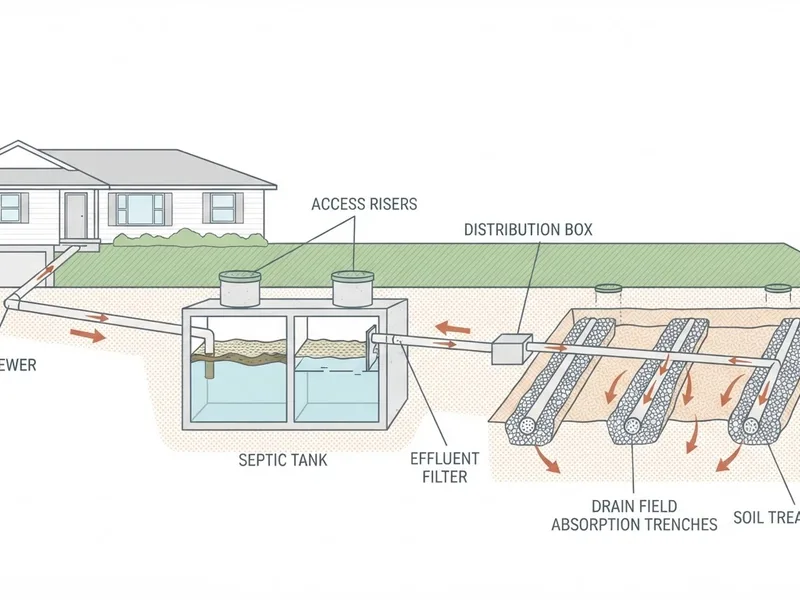
A typical septic tank is a buried box that holds wastewater from the house. Many homes use a tank of at least 1,000 gallons, but the exact size depends on the number of bedrooms and local rules.
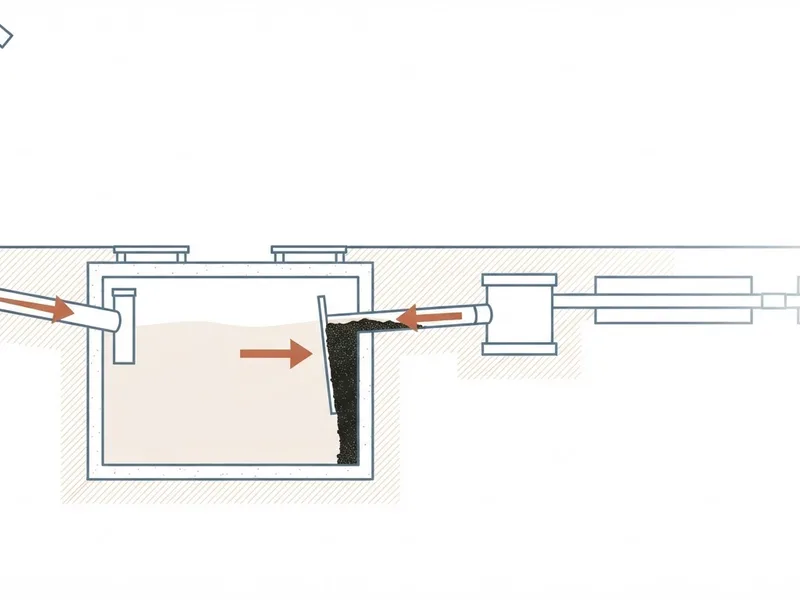
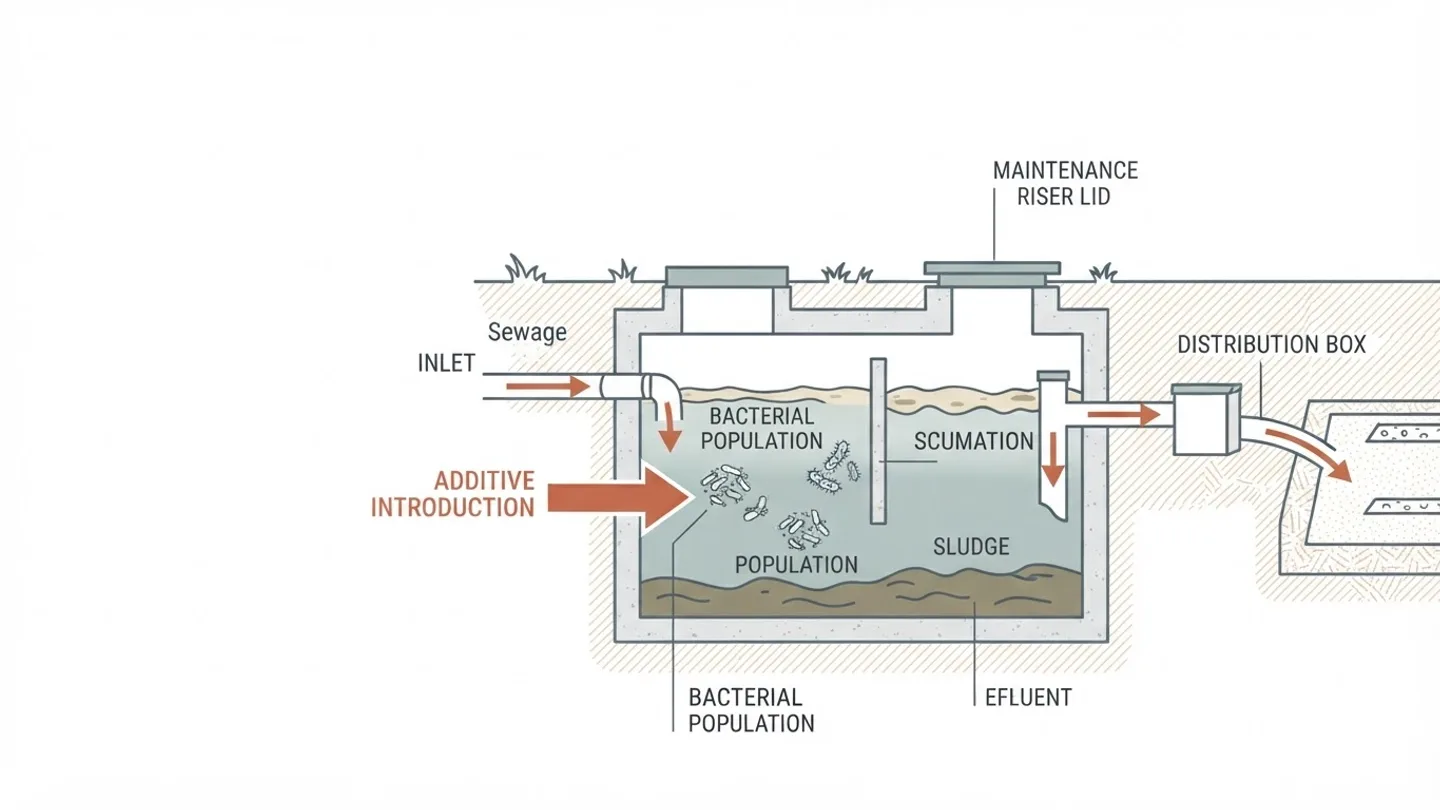
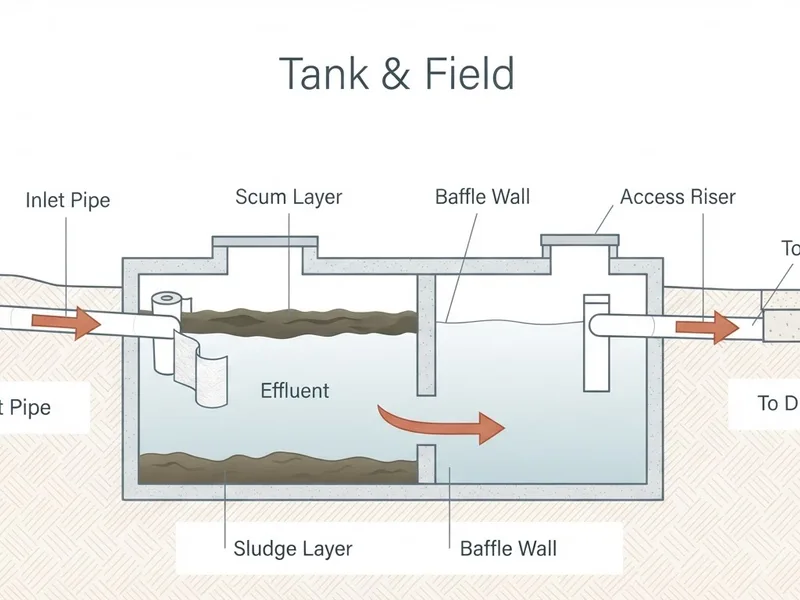
Inside the tank, solids separate. A scum layer, which is floating oils and soap, sits near the top. Sludge, which is settled solids, sits near the bottom. The clearer water in the middle, called effluent, leaves the tank through an outlet pipe.
The tank has baffles, small walls or tee fittings that keep scum and sludge from moving out too fast. Some outlets have an effluent filter, a screen that catches particles. If a baffle breaks or a filter clogs, water cannot leave and pressure can return to the house.
Downstream, the drain field is a network of pipes, gravel, chambers or sand. Effluent seeps into soil, where microbes treat it. A biomat can form in wet soil around pipes, a natural layer of growth that limits flow if the field is overloaded.
If too much water reaches the field, from laundry, rain or a failed pump, the field cannot absorb it. The tank stays full and backups happen. A distribution box, a small box that splits flow into field lines, can also plug or tilt and push water the wrong way.
The backup might not be the septic system at all. The house line from the building to the tank can be blocked by roots, grease or a collapsed pipe. If only one fixture is slow or backing up, that blockage may be closer to the house.
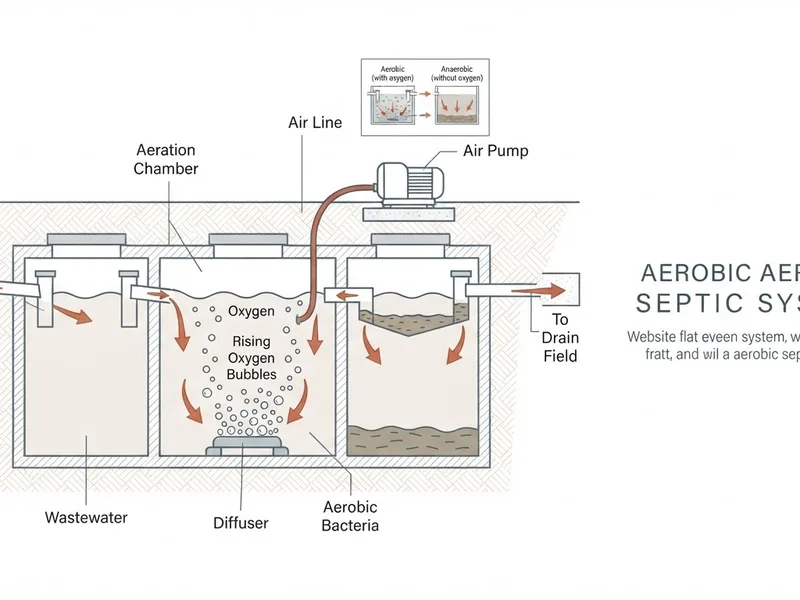
In an aerobic system, which uses air to help treatment, a blower, pump or control panel can fail first. A mound system, which raises treated water above natural soil, often depends on a pump or valve. If an alarm sounds, take the alarm seriously and call for help instead of guessing.
Cause
What you notice
What usually happens next
Tank is full
Slow drains, backups after laundry, no recent pump receipt, odor near the tank
Pump the tank, then inspect baffles and outlet condition
Outlet or effluent filter is blocked
Water rises in a low drain, odor near the outlet, the tank may still be wet in the yard
Clean the filter, check the baffle and clear the outlet if safe
Drain field is overloaded or failing
Soggy ground, smell in the yard, repeated backups during rain or heavy use, pump may run long
Confirm water level after pumping, ask about field repair and get a second opinion
House line is blocked
Only one fixture backs up or is slow, other drains work, no wet yard near the tank
Plumber snakes or cameras the branch line from the house to the tank
Likely causes compared
What a pumper checks
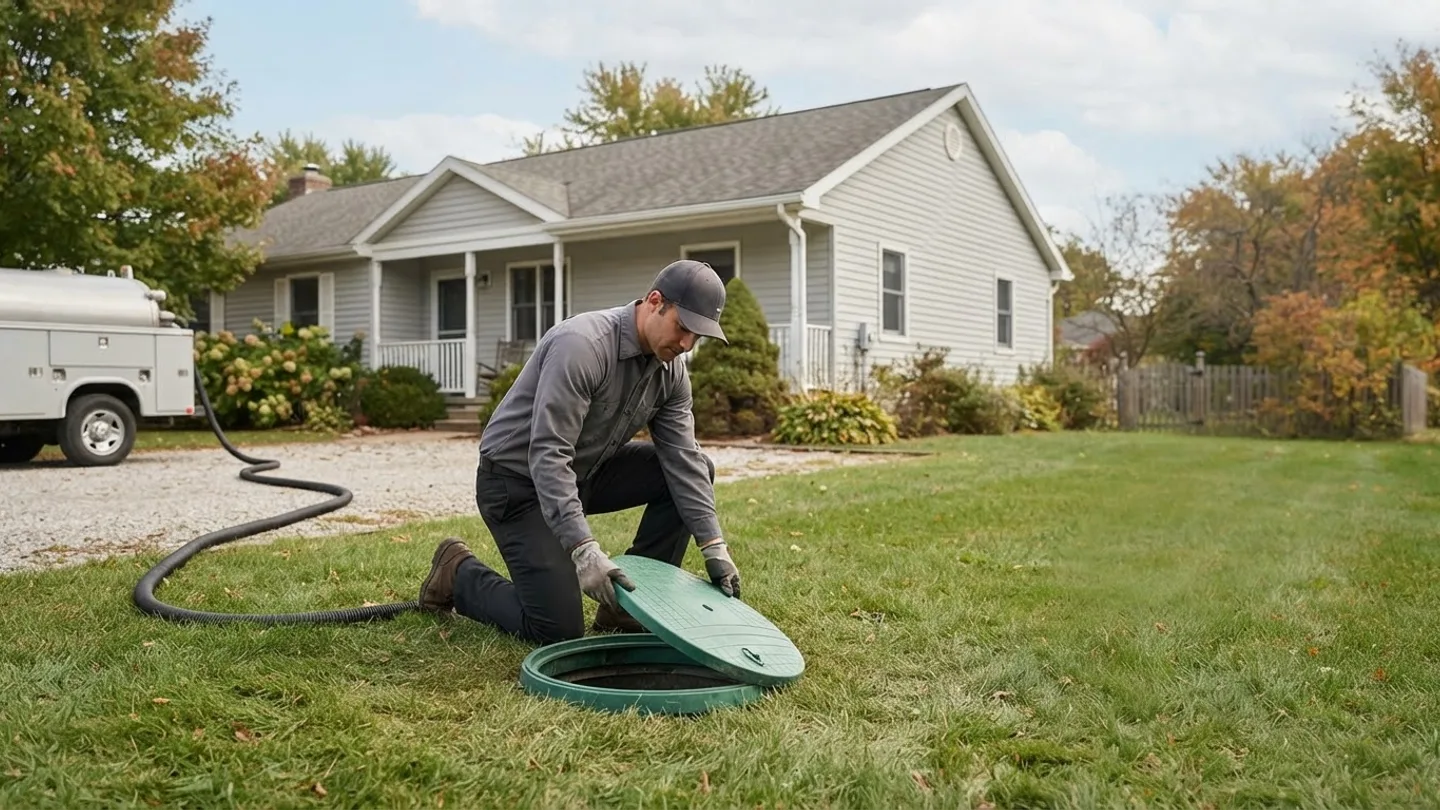
Locate the tank and field
They ask about the yard, probe for lids or use a tank finder. A good crew will explain what they found and why access matters.
Open and measure
They check the liquid level, scum layer and sludge depth. If sludge is too high or scum has escaped, that can explain a backup or a plugged field.
Check the outlet filter and baffles
They look at the effluent filter, if present, and the inlet and outlet baffles. A missing, cracked or blocked baffle is a common cause of solids leaving the tank.
Test flow
After pumping, some technicians run a fixture to see if water moves toward the tank. Not all pumpers do a full inspection, so ask what they checked.
Look at the field
They check for wet soil, odor, high water, a running pump and overflow at the distribution box. If the field is soaked, pumping alone may not solve the problem.
Write the report
Ask what was pumped, what layers were seen, what was cleaned or replaced, and what still needs repair. A written note is more useful than a vague promise.
What affects the cost
The bill usually starts with pumping. Price moves with distance from the truck route, tank access, excavation needed to find lids, amount pumped and disposal fees.
If the tank empties but the backup continues, more work may follow. Clearing a clogged outlet pipe or filter can take jetting. Camera work by a plumber can add cost.
A drain field repair is a bigger job. It may require a county health department permit, excavation, new pipe, gravel, sand or chambers. Replacement costs vary a lot by region, soil and site access.
A second opinion can save money. If a pumper says a field replacement is needed based only on pumping, ask for written observations: sludge depth, scum, outlet condition, water level, wet field and whether the distribution box was checked.
Ask before you hire. Is this a pump quote or a repair bid? What is included? Who will dig, if digging is needed? Does the company hold any required permit or license? Will the report show the date and system location?
Do not choose by lowest price alone. A rushed pump without looking at baffles, filter and field conditions may leave the real cause unfixed.
Common questions
What if only the basement shower backs up?
A single low fixture can point to a house line blockage. If other fixtures drain normally and there is no yard symptom, start with a plumber. If several fixtures back up or the ground over the septic line is wet, call a pumper.
Can additives fix a septic system backed up?
Usually no. Additives do not clear a full tank, a broken baffle, a blocked outlet pipe or a failed drain field. They can also interfere with some systems. Do not spend money on them during an active backup.
Should I pump first or call a plumber first?
If the yard smells, the ground is wet or multiple drains are affected, call a pumper first. If the tank was pumped recently and only one fixture is affected, a plumber may be faster.
How long can I wait?
Do not wait if drainage is entering the house or the ground near the tank is wet. If symptoms started this morning, keep water off and call today.
Does this mean I need a new drain field?
Not always. Many backups are caused by tank solids, a clogged filter or a blocked outlet. Repeated backups after pumping and filter cleaning point more toward a field problem.
Is it safe to open the tank to look?
No. Open tanks are hazardous. Stay away from the lid and let the pumper or an inspector handle access.
Call a qualified pumper
Tell them you think your septic system backed up, list the fixtures affected and note when drainage entered the house.
You pour a cup of drain cleaner into a kitchen sink, wait a while, and the water still sits there. Your house runs on septic, so the next thought is less about the sink and more about the tank in the yard.
Drano is common, so the question is normal. The honest answer is that one use is not the same as a habit. A slow drain can also be a sign that the system needs care, not another bottle.
Contents in this article on Drano and septic systems
What this covers: How harsh drain cleaners affect septic systems, gentler ways to clear a slow drain, and when to stop guessing and call.
Systems it applies to: Conventional gravity tanks, aerobic systems with pumps or blowers, mound systems, and systems with newer or older drain fields.
Typical cost range: This is not a cost guide. Prices vary by town, tank size, and whether the repair is a pump out, a clogged filter, or a drain field problem.
How urgent it is: Moderate for one slow drain with no odor. High for indoor backups, sewage smell outdoors, or soggy grass over the drain field.
Homeowner job or pro job: A homeowner can use gentler methods for one sink or tub. A pro should handle multiple slow drains, tank odor, wet ground, or sewage backups.
Occasional use is not the same as repeated use
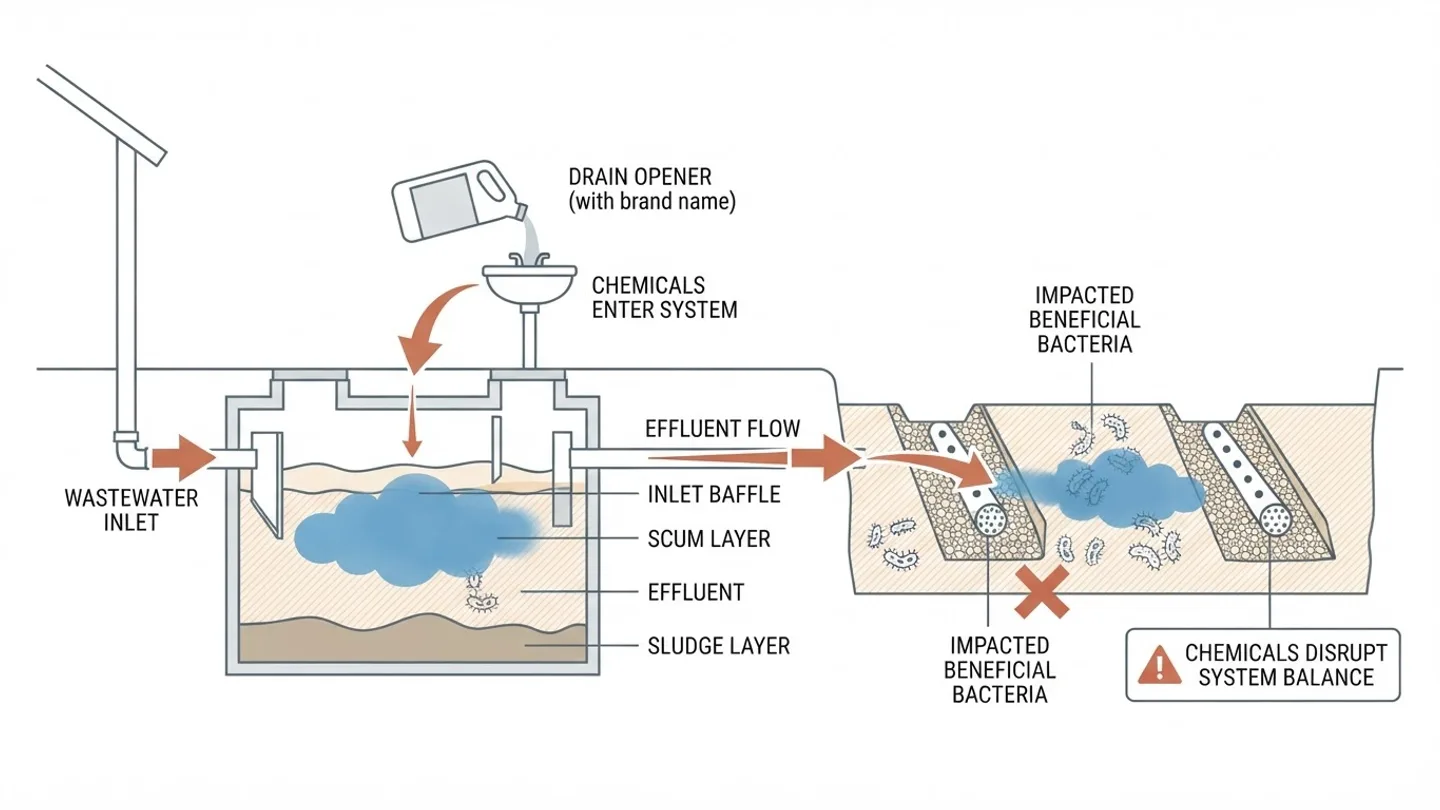
Many drain cleaners sold in stores, including some Drano products, work with caustic chemistry. Caustic means strong alkaline, often lye based. That chemistry can eat organic buildup, but it does not dissolve a tree root, a toy, a wad of hair that has turned into a rope, or a blocked tank outlet.
Inside a septic tank, living microbes do the main work. They break down solids so the liquid that leaves the tank, called effluent, can soak into the soil without overloading the field. Sludge, the settled solids at the bottom, and the scum layer, the floating grease on top, grow over time. That is why pumping matters.
A single dose of caustic cleaner, used once and then followed by normal water use, may pass through a healthy tank without shutting the system down. Repeated doses are a different story. They can kill or weaken tank microbes, raise pH, the balance between acid and base, and leave harsh residue behind. In older homes, that residue can also attack metal pipes, thin gaskets, and shorten the life of parts that are hard to reach.
Aerobic systems are especially sensitive because they rely on an air fed treatment zone. Do not add any harsh chemical to an aerobic unit unless the manufacturer care sheet clearly says it is safe. Mound systems often add pumps, floats, and controls, and those parts do not benefit from a chemical flush.
Option
What it helps with
Septic system risk
Good time to try
Hot water and dish soap
Grease light buildup in a sink trap
Low, but do not use boiling water in old pipes or PVC that can soften
A sink drains slowly after cooking
Plunger
Air pressure on a simple blockage
Low
One sink, tub, or floor drain
Enzyme cleaner
Organic buildup in drain lines
Low risk to microbes, but not strong enough for roots, toys, or a saturated field
Routine maintenance or mild grease odor
Drain snake or auger
Physical hair, grease, and minor blockages
Low risk if used gently, but a deep line snake can disturb a field or damage a pipe if forced
One fixture stays slow after hot water and plunger
Septic safe drain cleaner
Light organic film
Low to moderate, depending on formula, check label
When you need a store cleaner and want a gentler option
Drano or similar caustic cleaner
Stubborn organic clog in a household line
Low if one time in a healthy system, higher with repeats, old pipes, aerobic systems, or a tank that is overdue for pumping
Last resort, not a routine solution
Licensed plumber or septic professional
Unknown cause, repeated slow drains, backup, suspected field problem
Low when they know septic, but cost and scheduling apply
When DIY clears nothing or signs point to the tank or field
Safer ways to clear a slow drain compared with Drano use
When a slow drain is really a septic sign
A slow kitchen sink after a big meal may be grease in the trap. A tub that gurgles and drains better after a day may be a partial line blockage. A drain that clears after chemical treatment and then slows again every few weeks may be telling you that the tank is full of sludge, the outlet screen is clogged, or the soil under the field is getting overwhelmed.
There are a few names worth knowing. A baffle is a plate or pipe at each end of the tank that keeps solids from escaping. An effluent filter is a screen, often at the tank outlet, that catches fines before liquid goes to the field. A distribution box spreads liquid among field lines. A biomat is the natural slim mat that forms under the pipes, a healthy biomat helps filter, but too much of it can choke the field.
A mound system uses sand, gravel, or a pump chamber to spread liquid. If its pump or float is faulty, chemicals will not fix it. A septic backup is not the time to guess.
Do this now if water backs up
Stop running water
Tell everyone in the house to avoid showers, laundry, dishwashing, and faucets. Every added gallon goes straight into the part that is already failing.
Do not pour more drain cleaner
If you have used Drano before the backup, do not add more. It will not clear a tank, outlet, filter, or field problem, and it can make the next repair call dirtier and less safe.
Check the outside first
Walk the yard. Look for standing water, very wet or squishy grass, strong odor, or grayish water near the tank or field. If you see any of that, treat it as a septic system call, not a plumber for one sink.
Keep people and pets clear
Do not let children or pets play near the wet area. If sewage is in the basement, keep electrical panels, cords, and outlets dry. If contact happens, wash skin and clothing well.
Call with a short description
Tell the pro whether the backup is indoors, outdoors, one fixture, or the whole house. Say the last time you pumped the tank, if you know it. That information helps them bring the right truck, pump, and safety gear.
Questions homeowners ask
Can I use Drano once in a septic tank?
A one time use in a single sink line is unlikely to stop a healthy tank by itself, but it is not a good habit. Use a plunger or snake first. If the system has an aerobic chamber, avoid harsh cleaners unless the care sheet says safe.
Will Drano clear a slow drain field?
No. Chemical cleaners do not fix saturated soil, a blocked distribution box, a failed pump, or roots in the field lines. If the problem is under the drain field, a pump out, clearing an outlet filter, or field repair is the conversation you need.
Are enzyme cleaners safe for septic systems?
They are gentler than caustic cleaners and can help manage light organic buildup. They are not magic. A thick sludge layer, a plugged baffle, or a clogged field will not respond well to any additive. Do not buy enzyme products as a substitute for pumping.
What should I avoid flushing or pouring into septic lines?
Cooking grease, wet wipes, cotton swabs, paper towels, paint thinner, gasoline, strong bleach, antibacterial cleaners, and harsh drain products. They either add solids, harm microbes, or damage pipes and pumps.
How often should a septic tank be pumped?
It depends on household size, tank size, water use, garbage disposal use, and local rules. The only way to know yours is a lid opening inspection that measures sludge and scum depth, or service records.
Does using a garbage disposal make septic problems worse?
It can add food solids and grease. If you have one, conserve water, spread laundry loads, and expect more frequent tank inspections.
The alarm light on your aerobic treatment unit is on, and you are standing in the yard with a cup of coffee. That is the usual way people start thinking hard about an ATU. It is a working system, not just a tank buried under grass.
An aerobic septic system uses air to help bacteria break down solids faster than a conventional tank. Because that air moves through a pump and small diffusers, the system needs a few simple owner checks and regular service visits.
This guide separates what you can do from what the service company should do. It also covers how often visits happen, what owners usually pay, and when the alarm should not wait until Monday.
What it covers: owner checks, contractor tasks, service frequency, yearly cost and honest advice on additives and contracts.
Which systems it applies to: aerobic treatment units with an air pump or blower, chlorination or UV disinfection, and spray or drip dispersal.
Typical cost: a routine service contract often runs $300 to $800 a year. A year that includes pump out, tablet supply, parts or pump replacement can move above $1,000.
Urgency: low for routine checks. High if the alarm stays on, sewage backs up into the house, the yard goes wet over the tank or field, or spray stops.
Who does what: you check the alarm, tablets, spray heads and records. The pro handles electrical parts, the air pump, diffusers, sludge levels and repairs.
Why air matters in an aerobic septic system
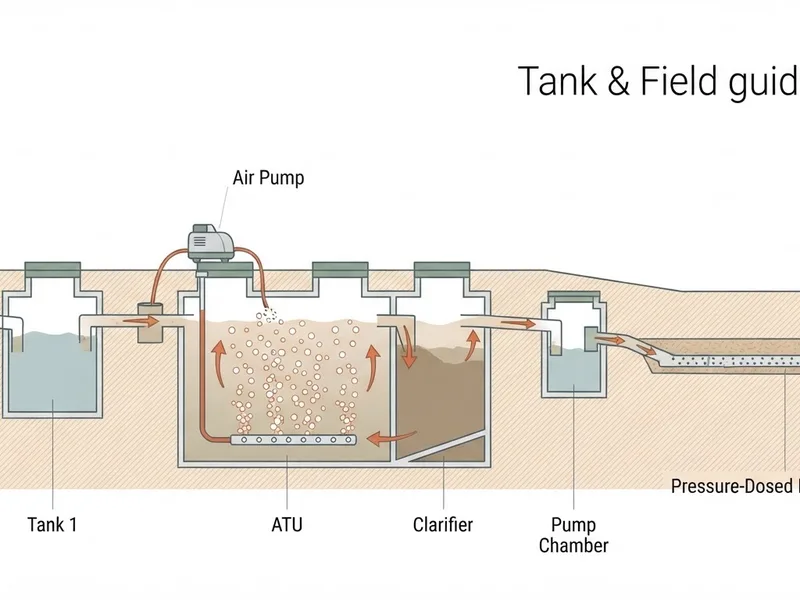
A conventional septic tank works mostly without added machinery. The tank separates solids, and the soil does a lot of the cleanup after the liquid leaves the tank. An aerobic system adds a blower or air pump, and it often adds disinfection before the liquid leaves.
The air pump feeds tiny bubbles through diffusers. Diffusers are small porous devices that push air into the water. The oxygen helps aerobic bacteria grow and break down organic material.
When the pump fails, the power drops, or a diffuser plugs, the bacteria lose oxygen. The system may still look quiet in the yard while untreated water moves toward the drain field.
Because of that, a healthy ATU is partly a living bed and partly a piece of outdoor machinery. You can do the simple owner checks. You should not try to rebuild most electrical and aeration parts yourself.
Area
What you do
What the service company does
Why it matters
Alarm light
Check the light, note if it is steady or flashing, and write the time.
Find the cause, such as a pump failure, float problem, power loss or clogged air line.
The alarm is the system telling you it has stopped working as designed.
Chlorine tablets
Replace approved tablets if the label says owners can do it. Wear gloves and keep tablets dry and out of reach.
Confirm the correct dose, check the chlorinator or UV unit, and document the system type.
Too little disinfection can be a permit problem. Too much can upset spray plants and soil biology.
Spray heads
Keep dirt, tall grass, snow and debris away from the spray pattern.
Flush lines, clean nozzles and check for weak coverage.
Blocked spray can pond in the yard, leave streaks dry, or send water back toward the tank.
Air pump or blower
Listen for a steady low hum while you check the alarm.
Test, service, replace or repair the pump and related electrical parts.
No air means poor treatment, even if the tank still has water.
Diffusers
Do not try to clean them yourself.
Remove, inspect, clean or replace diffusers.
Small plugged diffusers reduce oxygen and can let solids move farther than they should.
Tank solids
Ask to see sludge and scum levels during the visit.
Check sludge and scum, clean the effluent filter, and pump the tank when needed.
Aerobic tanks vary in how often they need pumping. Sludge level matters more than a fixed calendar.
Water use
Spread out laundry and be careful after gatherings or new guests.
Recommend capacity limits and flag warning signs from flow testing.
ATUs have less room for surges than many conventional systems.
Paperwork
Keep service reports, pump records and permits in one folder.
Provide written reports when the system, contract or local rule requires it.
Records can save time during a sale, permit renewal or dispute about repair scope.
Owner tasks and contractor tasks side by side
A monthly owner routine that takes ten minutes
Check the alarm while the coffee is hot
The alarm should normally show power, not an active fault. If a red light is steady or flashing, note the time and whether anything changed in the house, such as heavy water use, a power outage or recent rain.
Listen near the air pump
Stand where the pump or blower is. A working unit usually has a steady low hum. If it is silent and the alarm is on, that is a service call, not a tablet fix.
Walk the spray area
Look for heads that are buried, broken, spraying too low or leaving dry patches. Tall grass and dirt piles are easy fixes. A head that will not turn needs service.
Check tablet count or disinfection status
If your system uses chlorine tablets, confirm there is tablet left and that the housing is closed. Do not guess about dose. If you are unsure, ask the contractor before the next visit.
Think about water use for the next week
A big laundry day, a party or a new guest can stress a small ATU. Spread water use out if the alarm has been acting up or the spray area looks wet.
Write one line or take one photo
Keep a simple note: date, alarm status, tablet status and any odd spray. A small folder of service papers is far easier to carry than a stack of loose receipts.
Service visit frequency, contract terms and yearly cost
Many ATU service companies visit twice a year. Some local rules, manufacturers or first-year installs call for quarterly checks, then twice a year after that. Some sensitive areas require more frequent service because soils are tight or the system must be documented for a permit.
A normal visit should include the alarm, electrical connection, pump or blower, air flow, disinfection unit, tablet housing and spray heads. The contractor should also look at solids if the system has an inspection opening. You should get a written note or report, especially if the service was done for a permit or a sale.
For cost planning, a routine contract often falls in the $300 to $800 a year range. The low end usually means inspections and tablet checks. The high end may include tablet supply, minor clearing, travel in rural areas and a more complete report.
The surprise comes when parts are involved. A new blower, pump, control board, float switch or air line can push a single year above $1,000. A full tank pump out can be part of the contract or a separate charge, so ask before signing.
If a quote includes drain field replacement, ask what failed. A weak spray head, a plugged pump or a clogged diffuser is not automatically a failed drain field. Get two or three written estimates. Ask what each visit includes, who pays for parts under warranty, and whether the contractor can show a recent service report for a system like yours.
Rules vary by state. Your state may require licensed service companies, written contracts, service reports or inspection records at sale. Read the state contract rules page before signing a maintenance contract.
Common questions about aerobic septic system maintenance
Can I add septic additives to my aerobic system?
Most additives are not a substitute for a working air pump, clean diffusers and proper sludge checks. Some products can even harm treatment. Use chlorine tablets only if your system is designed for them and the dose is correct. For other additives, be skeptical unless the manufacturer or your permit requires them.
Why is my ATU alarm going on and off?
On and off alarms can come from a failing float, weak pump, power issue, clogged air line, blocked filter or high water use. If it repeats after a reset, get service. The alarm is not decoration; it usually means air, disinfection or flow is off.
How often should an aerobic tank be pumped?
There is no reliable calendar answer for every system. Aerobic tanks vary by size, household use, solids volume and service design. The sludge and scum level matters more than the year on the calendar. Ask the inspector to show you the level and tell you when it should be pumped.
Should I handle chlorine tablets myself?
Sometimes yes, if your manufacturer or contractor says owners may replace approved tablets. Always follow the label, wear gloves, keep the tablets dry and close the housing correctly. If you are unsure, make a note and let the service visit sort it out. Too much chlorine can be as unhelpful as too little.
Can I use a garbage disposal on an aerobic system?
Some ATUs have less room for grease, fibrous waste and solids than a conventional tank. Many homeowners can use a disposal carefully, but heavy use can raise solids and cause strain. Check your permit or manufacturer instructions. If your spray area is wet or the alarm keeps returning, stop using the disposal until a pro looks at it.
What should I have ready when selling a house with an ATU?
Keep recent service reports, pump records, permit copies and a photo of the tank location or riser if you know it. If the buyer's inspector calls the system marginal, ask for the specific failed item, such as pump, alarm, disinfection, spray coverage, or sludge level. Do not accept vague repair language that points to a full drain field without test evidence.
You just moved into a house with a septic tank, and the kitchen sink has a disposal switch that no one explained. The first time you push it, a question follows: can you have a garbage disposal with a septic tank, or are you asking for a slow drain in a few months?
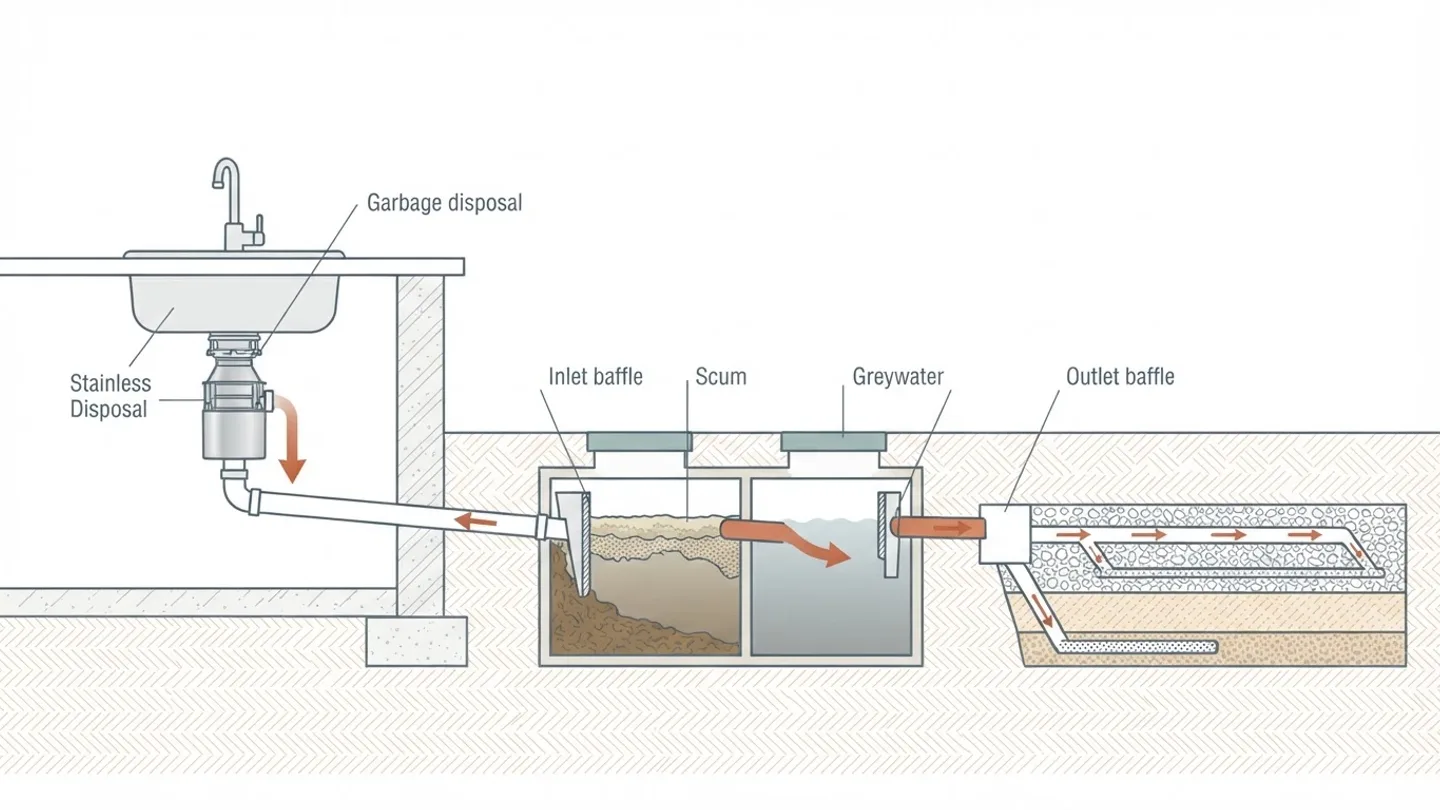
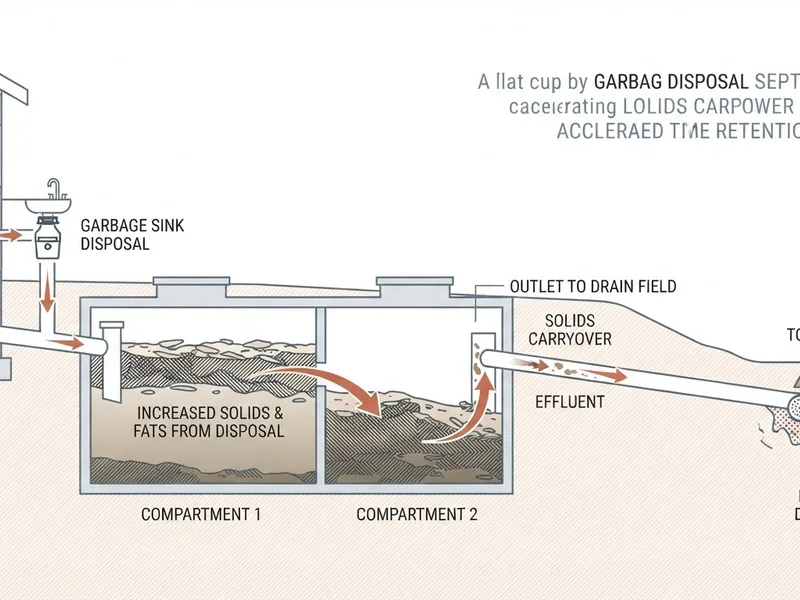
Yes, most septic systems can live with one, but there are tradeoffs. A disposal sends extra food solids into a tank that already has to separate liquids, settled solids and floating grease. That can thicken the sludge layer, speed the need for pumping, and put more tiny particles near the drain field.
If you keep the load small, avoid bad scraps, and watch the tank, it can work. If you want the least maintenance, a compost pail and a trash can are usually safer.
A garbage disposal can work with a septic system, but it is not a free pass to treat the sink like a sewer.
A 1,000-gallon tank serving a typical three-bedroom home has fixed space for solids and liquids.
Food solids that settle are sludge. Grease and light bits that float are scum.
Grease, coffee grounds, celery, corn husks, artichoke leaves and bones are poor choices.
An effluent filter protects the drain field but needs more cleaning.
A bigger tank may delay problems, not remove them.
Composting scraps is often the lower-risk habit.
How a disposal changes the tank
A disposal grinds scraps into tiny pieces, but it does not erase them. Those pieces go into the tank, where the first job is separation. Food solids that settle to the bottom are sludge, a soft layer of organic material. Grease and lighter solids float as scum, a thinner layer on top.
When you run a disposal often, more organic material enters the first compartment. That gives tank bacteria more work, but bacteria cannot digest everything fast enough. Coffee grounds, eggshell dust, fibrous plant matter and fats add bulk that does not simply vanish.
Liquid that leaves the tank is called effluent. A baffle, a wall or pipe at the inlet and outlet, helps keep the floating scum layer away from the outlet. If too many tiny solids leave the tank, they can travel to the distribution box, the part that splits liquid across the drain field, then into the soil.
A septic service does not pump out liquid. It removes accumulated solids. More food solids means the solids space shrinks faster. So the real question is not only can you have a garbage disposal with a septic tank. It is whether your tank size, household water use and soil condition can handle the extra load.
For a new owner, the safe rule is to use the disposal sparingly. Treat every grinding run as a small addition that may bring the pump truck back sooner. If your service provider set a checking interval, ask for a review after a year of new habits.
Factor
With a garbage disposal
With a compost bucket
Food solids
Adds more solids to the tank
Keeps scraps out of the tank
Water use
Uses sink water with each run
Little extra water
Tank maintenance
May bring pump dates forward
No added tank load
Odor and pests
Scraps can sit in the sink or drain
Compost pail needs a lid and regular emptying
Convenience
Fast cleanup from a plate
A few extra steps
Drain field risk
Higher with grease, fibers or big loads
Lower
Best for
Careful homes that can accept extra maintenance
First-time septic owners and older systems
Disposal vs compost bucket
Foods never to grind
Never treat the disposal as a trash can for the whole kitchen. Some scraps break apart. Others clump, swell or pass through the tank as hard bits.
Grease, oils and fat should not go into a septic tank, with or without a disposal. They rise as scum and can coat pipes. Do not grind bacon drippings, butter, cooking oil, gravy or pan fat.
Coffee grounds are a common mistake. They can build a fine layer in the tank and may plug an outlet filter.
Fibrous vegetable matter is rough on a disposal and a septic tank. Celery strings, corn husks, onion skins, artichoke leaves and cabbage cores can wrap around parts or travel as chunks that resist digestion.
Eggshells, fruit pits, bones and shell fragments are hard on blades. They also add grit that does not disappear in a drain field.
Bread, rice and pasta can turn pasty in water. Large starchy loads can take up space and add to sludge.
Non-food items are a hard no. Do not grind paper towels, dishcloths, cotton swabs, dental floss, bandages or wipes. Wipes can cause trouble in septic systems, so leave them out.
Small amounts of soft cooked vegetables may be okay. Still, a lid on a compost pail and a trash can keep more waste out of the tank.
Pros
Quick plate cleanup with less bagged trash
Small amounts of soft cooked food do not need to sit near the kitchen
Can be convenient for a household that already has a healthy system
Works if you run water and keep loads light
Does not require a new install if your tank and field are in good shape
Cons
Adds organic solids that take up fixed tank space
Can shorten the time between pumping visits
Increases cleaning needs for an effluent filter
Risk of slow drains if grease or fibers enter the system
A bigger tank may only delay symptoms
Poor choice for rentals or houses with a weak field
When a bigger tank or filter matters
If you want to use a disposal with less risk, two hardware choices may come up: tank size and an effluent filter.
A bigger tank does not make food disappear. It gives more retention time and more space between the bottom sludge and the outlet. That can help a small household or a system with short pipe runs, but it does not create unlimited capacity.
Tank size rules vary by state and county. Some health offices set minimum tank sizes based on number of bedrooms or daily water use. If you plan to add a disposal during a renovation, ask the local health office or your installer about the current tank. Do not assume it is allowed just because the previous owner had one.
An effluent filter sits at the tank outlet and catches particles before they enter the distribution box. A filter is a good defense for the drain field, but it increases maintenance. Expect to inspect and clean it more often, especially if you use the disposal.
A filter is not a substitute for pumping. It is a screen at the end of the tank. If you skip cleaning, it can back liquid up toward the house and show as slow drains or a smell near the tank.
Use an effluent filter if your service provider recommends it, if your drain field has failed before, or if your soil is slow to accept water. If you do not want extra tank visits, keep disposal use light or skip it.
Frequently asked questions
Can a garbage disposal damage a septic system right away?
A healthy tank usually does not fail from one good use. Problems show over time if you add too many solids, too much grease or too much fiber. Slow sinks, gurgling pipes or wet grass over the drain field are signs to stop grinding and call for a check.
Do I need a bigger septic tank?
Sometimes. If the current tank is small for the household, if daily water use is high, or if local rules require a minimum, a larger tank may make sense. A larger tank gives more space for solids, but it does not remove food solids.
Are effluent filters worth it?
They can protect the drain field by catching particles at the tank outlet. They are worth it if you are willing to clean them. If you grind often and avoid filter cleaning, the risk moves from the tank to the field.
Can I grind coffee grounds?
It is better not to. Coffee grounds can build a fine layer and may plug a filter. Compost them instead.
What foods are most likely to cause trouble?
Grease, oils, fat, coffee grounds, eggshells, bones, fruit pits, celery, corn husks, onion skins, artichoke leaves and large starchy amounts are common problems.
Does an aerobic system change the answer?
Yes. Aerobic systems have added treatment and often more sensitive parts. A disposal can increase solids and maintenance load. Follow your installer or service provider, and do not assume a standard gravity tank rule applies.
Can I keep a disposal in a rental house?
You can, but set clear rules for tenants. Do not let renters grind grease, wipes or large scraps. Check tank solids during routine maintenance, and keep a trash can nearby for bad habits.
What should a home inspection cover if the seller had a disposal?
Ask the inspector to note tank size, filter condition, sludge and scum depth, baffle condition, water use habits and signs of field overload. A disposal by itself is not an automatic fail. A saturated field or repeated backups is a real concern.
At a glance: a working, regularly pumped septic system generally does not need additives. No additive replaces pumping, and none fixes a failed drain field. A product may be inexpensive, but the money saving claim is weak. Pumping, inspection, water use, and repairs belong to a licensed pro.
You may see bacteria, enzyme, oxygen, or chemical bottles at a hardware store and wonder whether they help or simply make the tank feel fresher. The honest answer is that many products do not make a maintained system better, and some can push a small problem downstream.
This guide covers what septic tank additives claim to do. It also gives a plain checklist for when to skip a product and call a professional, so you do not spend money on a bottle while a tank, filter, baffle, or field waits for attention.
In this guide: what the evidence says about septic tank additives, product types, risks, and the better next steps for a maintained septic system.
A septic tank is a quiet separator. It lets solids fall to the bottom, where they turn into sludge. Lighter material floats near the top, where it forms a scum layer. The clearer liquid between those layers, called effluent, leaves the tank through a baffle, a divider at the outlet, or a filter.
Most additives promise to act on one part of that picture. Bacteria products claim to speed sludge digestion. Enzyme products claim to break down paper, grease, or solids. Chemical products claim to cut fats or keep lines moving. Oxygen tablets claim to boost microbes in a field or aerobic chamber.
A few products also sell a broader story. They say the tank is starving, the field needs life support, or your system can go longer without pumping. That story is not the normal maintenance advice.
The tank is not an empty place waiting for good microbes. Household waste already brings microbes in. In a healthy system, a slow-growing community of bacteria and other organisms works in the dark, low-oxygen liquid.
Because the tank is already busy, adding more bacteria is usually like adding more cooks to a kitchen that already has too much work. It may not change the end result.
The better question is what is causing the trouble. Too much water at once, grease, wipes, disposal sludge, a clogged filter, or a high scum layer can create symptoms without a broken field.
Type
What it claims
What guidance suggests
Smart use
Bacteria
Adds helpful microbes to speed sludge breakdown.
A healthy tank already has microbes. Added bacteria are not shown to replace pumping for a conventional system.
Skip unless a manufacturer or inspector recommends it for a specific system.
Enzyme
Digests grease, paper, and solids.
Enzymes can react in a controlled cup, but a tank is dilute, slow, and full of competing material. They are not a reliable way to cut pumping intervals.
Do not rely on them for maintenance.
Chemical
Cuts fats, clears drains, and keeps the field open.
Public guidance often warns against routine chemical treatments. Some products can disturb microbes, move solids or fats downstream, or damage components.
Skip. Call a pro for a blockage.
Oxygen
Boosts microbes, reduces odor, and helps the field.
Oxygen can be useful in some designed aerobic systems, but it is not a fix for a saturated or clogged conventional field.
Use only if the system and manufacturer allow it.
Household
Yeast, sugar, detergent, or soap can treat the tank.
Home remedies are not a proven part of septic care. Laundry detergent is laundry detergent, not a tank treatment.
Skip.
Additive types compared by what they promise and what public guidance suggests.
What public guidance says
Public guidance for homeowners from EPA and state university extension offices is blunt on one point: a conventional septic system does not need additives as routine maintenance.
EPA materials treat a septic tank as a settling and storage chamber, not a place where store-bought treatments are required to keep things working.
Extension advice usually points to a short list: pump at intervals based on tank size and use, watch water use, keep non-household waste out, and check the system before trouble spreads.
That guidance does not recommend bacteria or enzyme products as a way to avoid pumping. Pumping is a physical removal of layers. A product can change chemistry for a short time, but it does not remove the sludge and scum that grow with household use.
Some state materials also caution that unregulated or poorly tested products may harm systems. If a label says the product replaces pumping, treat that claim as a warning sign.
Why a bottle can hide the real issue
An additive can make a symptom quiet for a while without fixing the cause. That is risky because a septic problem often moves in stages. The tank fills, the outlet slows, the field starts to struggle, and the yard shows it late.
If sludge and scum are already thick, mixing in a product may stir the tank without removing anything. Some liquids can emulsify fats, meaning they break them into smaller particles. Smaller does not always mean safer, because the particles can travel farther into the outlet or filter.
An effluent filter, a screen at the tank outlet, can trap fine grease and solids better than an open tank can. If a product pushes those fines downstream, the filter may clog, or the soil may face a harder load.
In an aerobic septic system, which uses blower air and more sensitive treatment steps, random products can cause real trouble. They can affect pumps, floats, disinfection parts, alarms, or the biological balance the unit depends on.
The biomat is another point homeowners often misunderstand. A biomat is a natural layer that forms in the soil around the field. It helps treat effluent but can also slow drainage if the system is overloaded. Additives do not rebuild a field that cannot accept water.
If you already see a wet patch, an odor near the field, or a backup, do not spend the day shopping for a miracle bottle. Check the tank first.
What works instead of routine additives
The practical version of septic care is not a monthly bottle. It is using less water at once. A big laundry run and a full house of showers can push more volume into a tank than it should settle, especially if the field is already slow.
Keep the wrong solids out of the tank. Wipes, feminine hygiene products, paper towels, grease, and disposal waste can add sludge or scum that a tank is not sized to handle. Even products labeled flushable can be trouble.
Keep harsh household chemicals out as well. Paint thinners, solvents, motor oil, and large amounts of drain cleaners are not septic tank care. They can harm microbes, pipes, or downstream components.
Pump by measurement, not by smell. A licensed pumper can measure sludge depth and scum depth at the outlet, check the baffle, and look at the effluent filter if present. Those numbers matter more than a label on a bottle.
If you are buying a home with septic, do not ask about additives first. Ask for tank size, pump records, inspection findings, water use estimates, and the field condition.
If a quote says you need a full drain field replacement, ask for the reason. Is the field truly saturated, is the tank level high, is the soil clogged, or is the system simply overloaded with water? A second opinion can save money and avoid unnecessary repair.
If you use an additive anyway, use it as an experiment, not a habit. Write down what you added, why you added it, and whether the symptom changed. That record helps a professional separate a real problem from a temporary scare.
If you see a septic problem now: a steady, practical order of operations for slow drains, odor, wet lawn spots, or backup.
Stop adding products
Do not keep pouring treatments while a tank is filling. The next step is measurement, not more chemistry.
Cut water use now
Delay laundry, limit showers, and hold off on other heavy fixtures until the system is checked.
Mark the symptom
Note where the lawn is wet, where odor is strongest, and whether indoor drains are slow. Do not dig over the field.
Check safety before touching the tank
If you know where the lid is, lift it only if it is secure and you are not alone. Never enter a septic tank. Gases inside can be dangerous.
Call a licensed pumper or inspector
Ask them to check sludge depth, scum depth, outlet level, baffles, filter, distribution box (the outlet box that splits flow to field lines) if accessible, and field conditions.
Get the plan in writing
Ask what caused the problem, what will be pumped or repaired, what will be monitored, and when to call again.
Common homeowner questions about septic tank additives and when they should not be used as a fix.
Should I put an additive in every month?
No. A working system does not need monthly treatments. If you have water, waste, or maintenance problems, add them only after a professional checks the system.
Can an enzyme product reduce pumping frequency?
No. Pumping is needed because solids build up in layers. Enzyme products are not a reliable way to make sludge disappear or to stretch pump intervals.
What if the product says it is septic safe?
A label is not proof that it helps. Ask whether it contains solvents, harsh acids, or strong surfactants, and ask your pumper or local health office before using it in a sensitive system.
What about odor tablets?
A little odor masking may help briefly, but a septic odor can come from a full tank, a vent issue, a clogged filter, or a saturated field. Look for the cause before treating it.
Can additives fix a slow drain field?
No. A slow field usually means hydraulic overload, clogged soil, or a damaged distribution box. Additives do not rebuild soil capacity.
Should I use an additive in an aerobic system?
Only if the manufacturer or a licensed inspector recommends it for that exact unit. Aerobic systems can have blowers, pumps, disinfection parts, and alarms that react badly to random products.
If a backup happens, should I dump a chemical first?
No. Stop water use, keep people away from standing wastewater, and call a licensed pro. Chemicals can create a false sense of motion while the real cause remains.
What to remember: skip additives as routine care, and use the money for a sound pump-out, inspection, and repair decision instead.
A healthy, regularly pumped system usually does not need additives.
Bacteria and enzyme products are not proven to replace pumping.
Chemical and oxygen products can be risky, especially in aerobic units.
Odors, slow drains, and wet lawn spots point to tank, filter, vent, water use, or field conditions, not a missing bottle.
Pumping by measurement and inspection by a licensed pro are better uses of money than routine treatments.
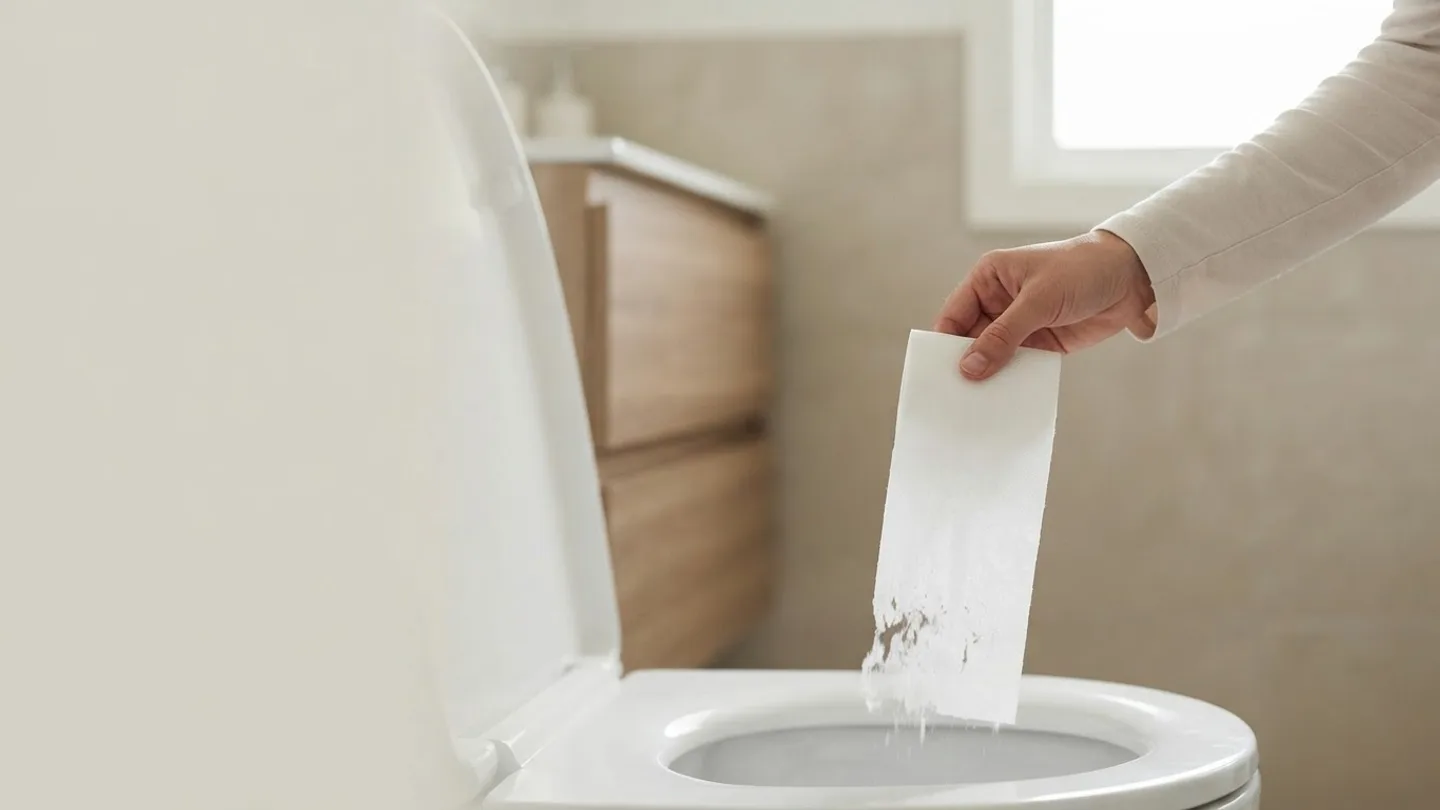
A bathroom paper backup does not start with a dramatic flood. It starts with two sheets sitting in the bowl, a slow drain, and a pumper visit. If your house runs on septic instead of city sewer, toilet paper choice matters less for the label and more for what happens inside the tank.
Most paper softens in water. The real question is whether it breaks apart before solids and fibers move toward the tank outlet, the baffle, and the drain field. A thick, plush sheet can look high end and still cause trouble if you flush too much of it at once.
This guide compares one-ply, two-ply, recycled, and bamboo paper. It also gives you a jar shake test, because the best toilet paper for septic tank systems is paper that you can flush in normal amounts and can verify in your kitchen sink.
Systems covered: conventional tanks, mound systems, and most aerobic systems. Check manufacturer rules if your unit has specific paper guidance.
What this guide covers: how fast paper breaks apart, a jar shake test, one-ply, two-ply, recycled, bamboo, and why amount matters more than brand.
Cost range: prices vary by store and pack, but expect to pay more per sheet for plush paper than for basic paper. Price does not predict septic performance.
Urgency: choose paper calmly now. If you have a backup, gurgling pipes, or wet soil over the drain field, stop flushing and arrange a septic check.
Homeowner job: run the jar test, watch flush size, and avoid wipes, paper towels, and facial tissues.
Pro job: a drain that stays slow after you fix the load, a smell in the house or yard, or standing water over the field.
Bottom line: the best toilet paper for septic tank systems is paper that breaks into fibers quickly and that you can flush in normal amounts.
What septic tank paper has to do
A septic tank is a holding and settling vessel. Water and small particles flow in, heavier material sinks as sludge, lighter floating material forms scum, and liquid called effluent leaves from the outlet.
The baffle at the outlet keeps much of that floating and settled material in the tank. On many modern tanks, an effluent filter, a screen at the outlet, catches small fibers before they travel farther.
Toilet paper is not the main thing a tank is designed to remove, but it is one of the few daily solids you control. The paper should loosen into small fibers before it reaches the filter, then the distribution box, which is the part that shares liquid among drain field lines.
In a mound system, where a raised drain field sits on imported sand because native soil is poor or shallow, a fiber buildup can cause trouble sooner than a homeowner might expect.
In an aerobic system, air keeps bacteria active, and some units have pumps, sensors, or filters that clog more easily. The paper does not have to be perfect, but it should not leave long, tough pieces that catch on moving parts.
So the goal is not a special toilet paper. The goal is normal paper that breaks down fast enough for your habits and your system.
Type
How it behaves in a septic tank
Good for
Watch for
One-ply
Usually breaks apart fastest and is often easy to flush in normal amounts.
Households with older tanks, slow drains, or heavy paper use.
It can feel thin and may tear during cleanup.
Two-ply
Many two-ply options still break down, but some stay in long pieces.
Good balance for homes with no known paper issues.
Avoid if the sheet stays waxy or intact after the jar test.
Recycled
Often made without new wood fiber and can break down well, depending on how it is bound.
Budget-conscious households with septic.
Some recycled sheets are rough or linty, which may irritate plumbing gaskets.
Bamboo
Can be strong when dry, but may hold together longer when wet.
Households attracted to bamboo paper.
Do not assume bamboo is better for septic without a jar test.
Labeled septic friendly
The label is useful only when it explains how the paper breaks apart.
A starting point, not proof.
Do not treat the label as proof; price and brand may matter less than amount and behavior.
Plush multi-ply
Thick sheets may absorb water slowly and remain in large pieces.
Comfort if you use very little.
Watch for large flushes and sheets that stay intact in the jar.
How common toilet paper types compare
How to run the jar shake test
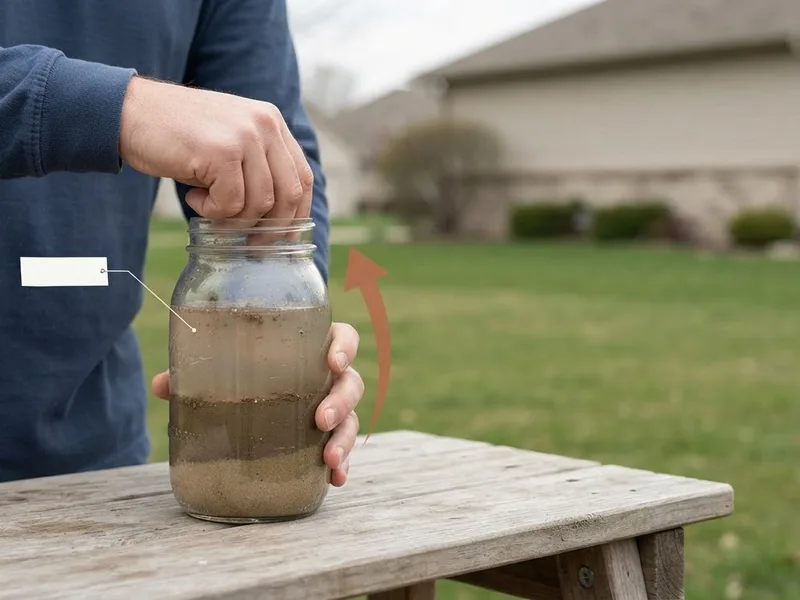
Fill a clean quart-size jar almost full with room temperature water. Add four squares of one brand, enough to fill the bottom without packing it tight.
Shake gently for 30 seconds, like the movement from a toilet flush. Let it sit for five minutes.
Look at the water and the paper. Good paper turns into a soft cloud of tiny fibers, and the water looks cloudy. Problem paper stays in big pieces, leaves a slippery lump, or keeps its sheet shape with only the edges loosening.
Do the same test for the brand you use and the brand you are considering. If you want a second check, shake the jar again after the paper has sat overnight.
What the jar test shows
The jar test is not a laboratory standard. It is a simple way to compare how paper behaves in water before it sits in your tank. Use the same amount, same water level, and same shake time for each brand you test.
The result tells you whether the paper is likely to loosen before it reaches the tank outlet and drain field. It does not replace pumping, inspection, or professional repair when a system is already failing.
Breaks into tiny fibers within 5 minutes
Likely okay for normal use.
Breaks into small fibers after 20 minutes
May be okay if you use fewer sheets.
Still one or two large sheets after 30 minutes
Avoid, or flush in much smaller amounts.
Leaves a slick film that does not cloud the water
Watch for buildup in older systems.
Best proof before buying
No label, price, or scent replaces the test.
Amount matters more than brand
Even fast paper can cause a clog if the load is too large. If you usually flush several sheets at once, try one or two squares at a time and keep the load loose.
If you use extra paper for a runny nose or cleanup, keep wipes, paper towels, and facial tissues out of the toilet. Even a wipe marked flushable can take longer than paper to separate.
Additives are not a fix for the wrong amount of paper. For routine toilet paper performance, many additives are a waste of money.
The same thinking applies to garbage disposals. Food solids add pressure to sludge, so paper choice matters when the tank gets more solids than a normal toilet and sink routine.
A simple habit saves more than a premium brand. Flush less paper at once, keep the tank lid or the riser, the extension that brings the lid closer to the lawn surface, accessible for inspection, and note what you see in the jar before buying a case.
A slow drain, gurgling pipe, or wet soil over the drain field is not always paper. It can be a tank nearing its pump interval, a filter fouled by solids, or a drain field that needs a professional inspection.
Frequently asked questions
Do I need special septic toilet paper?
No. You need paper that breaks into fibers quickly enough for your system and your habits. The label helps only when it matches the jar test.
Is one-ply always better?
No. Many two-ply papers pass. One-ply is often a safe starting point if drains are slow or the tank is older.
Does bamboo paper work?
Sometimes. Bamboo paper can be soft when dry and tough when wet. Run the jar test before you assume it is safe for septic.
How much paper is too much?
Enough that it clumps, slows the bowl, or leaves long pieces in the jar. Flush smaller loads and keep wipes, paper towels, and tissues out of the toilet.
You run the kitchen faucet and the sink takes a long time to empty. A week later, the toilet drains slower. It is easy to blame pipes, but a septic tank only has so much room, and the wrong items can narrow that room fast.
At a glance: this guide covers what not to put in septic tank, which items belong in trash or a waste facility, and what most homes can use in moderation. It applies to standard gravity septic tanks, aerobic systems and mound systems in the US. Typical cost range: the habit swaps cost little or nothing, while a blocked pump, full tank, clogged filter or damaged drain field can become a repair bill that varies widely by region. Urgency: low for prevention, high if you see slow drains, odors or wet ground over the field. Job type: homeowner tasks are sorting, flushing and water use habits, while a septic professional handles pumping, filter cleaning, baffle checks and repair.
Use the list that follows as a quick reference, then read the notes about wipes, grease, cat litter, coffee grounds, medications, paint and drain cleaners.
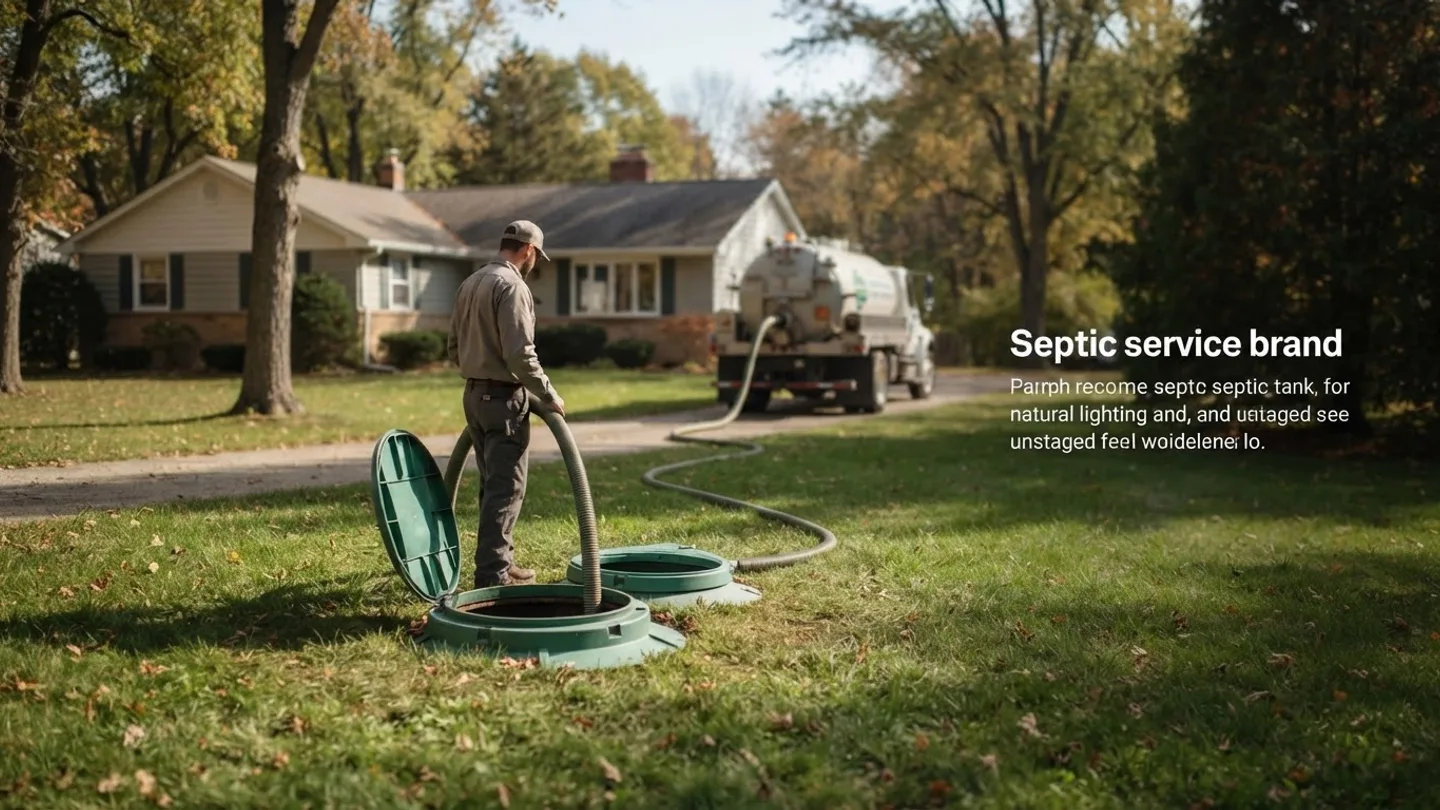
The pumper's truck pulls into your driveway. Before it leaves, you should know whether the tank was only emptied or also measured and checked. A good pumping visit turns a buried tank into a page you can read.
This guide walks through septic tank pumping from the homeowner side. You can help with lids and access. The pro does the suction, measurement, and inspection. When done well, the visit tells you if the tank is overdue, if a filter needs cleaning, and whether signs point to drain field trouble.
You just moved from city sewer. The first pump truck came and went, and now the next date is blank. How often to pump septic tank is a practical question, because the tank has to do its work before wastewater reaches the drain field.
The EPA guideline of every 3 to 5 years is the right starting point for most homes. Tank size, household size, garbage disposals, small tanks and aerobic treatment units then fine tune the date.
Covers: EPA guidance, a tank and household table, disposal effects, small tank effects, ATU and mound systems.
Systems: conventional septic systems, aerobic treatment units (ATUs), mound systems and other advanced systems.
Cost note: pump prices vary by state, tank size, access distance and disposal fees, so a local quote is better than a national average.
Urgency: routine. If you see a backup, yard odor, soggy grass over the drain field, or slow drains that do not clear, move up the schedule and call.
Homeowner job: keep records, note lid locations, watch the yard. Pro job: pumping, measuring sludge and scum, checking baffles and effluent filters, and ATU servicing.
Advice: additives are not a substitute for pumping. Most cheap additives are a waste of money.
The EPA guideline and how often to pump septic tank
The U.S. Environmental Protection Agency (EPA) gives a simple planning range: inspect a septic tank every 3 years and pump it every 3 to 5 years. The exact range depends on tank volume, number of people, how much water goes down the drain, and the amount of solids and grease entering the tank.
A tank is not a filter. It lets heavy solids sink into a sludge layer, which is settled material at the bottom. Lighter fats and floating debris form a scum layer at the top. The middle liquid, called effluent, flows out through a baffle, a tee or wall at the tank outlet, and through an effluent filter, a screen that catches small solids before they move on.
If sludge or scum gets too high, solids can escape into the drain field. That is where cost moves from pumping to repair. A pump out done at the right time is scheduled maintenance. A drain field repair done because the tank was ignored is a major job.
Tank size
Household
Start interval
Lean shorter or inspect yearly if
1,000 gallons
4 or more people
3 to 5 years
Lean toward 3 years. Inspect yearly if a disposal, heavy laundry, guest use, small tank age or ATU is involved.
1,000 gallons
2 to 3 people
3 to 5 years
Lean toward 4 to 5 years. Inspect yearly if a disposal, weekend use, unknown tank age, or an ATU is involved.
1,500 gallons
4 or more people
3 to 5 years
Lean toward 3 to 4 years. Keep an annual check if a disposal or advanced system is present.
1,500 gallons
2 to 3 people
3 to 5 years
Lean toward 4 to 5 years. A larger tank gives you room, but heavy water use can still fill it.
2,000 gallons or more
average use
3 to 5 years
Start at 5 years if use is light. Still inspect when you can.
Very small or old tank
any household
3 to 5 years
Start at 3 years and inspect yearly. Small tanks store less sludge, so the schedule can tighten.
ATU, mound or advanced system
any household
follow the manufacturer plan
Usually inspect yearly. Pumping may follow the plan, not only the tank size.
Pumping interval table by tank size and household size
Why disposals, small tanks and ATUs shorten the interval
A garbage disposal adds solids, fats and grease to the wastewater. Food scraps are one thing; cooking oil, coffee grounds and large amounts of food are another. A disposal does not automatically force pumping every 2 years, but it often pulls a family toward the shorter side of the EPA range.
Trash scraps in the compost bin, grease in the trash, and steady water use are simpler. If you still want to grind small amounts of food, plan for closer inspections and do not add additives to make up for it.
A small tank gives you less room. If the tank is older, unknown, or below the size your inspector expects, start at 3 years and check yearly. The tank can still work well, but there is less margin between a clean inspection and solids moving out.
An ATU, short for aerobic treatment unit, is a system with a blower or pump that adds air to help treat waste. Some ATUs also dose, disinfect, or send solids back to the first chamber. Because there are moving parts and a control system, ATUs need more scheduled attention than a simple tank. Annual inspection and service are common. Pumping still matters; a blower running does not mean solids are gone.
A mound system is a type of drain field raised above the native soil, often with sand and a dosing tank. It can be sensitive to water volume and solids. If the design or maintenance plan says check the pump, dosing and sludge annually, follow that schedule.
Write down what you know
Tank size in gallons, whether it is one chamber or two, lid locations, lid depths in inches if known, distance in feet from the road to the tank, and the last pump date. If you cannot find lid locations, ask the contractor to locate them or request the as built drawing from the county or installer.
Count people and water use
The number of people, guest weekends, laundry loads, disposal use, soaking tubs, and any sump or water softener discharge going into the septic system.
Name the system type
Conventional tank and drain field, aerobic treatment unit, mound system, pressure dosing or another advanced setup. Advanced systems may have a manufacturer maintenance schedule that comes first.
Choose the starting interval
Use the table above. For a conventional tank, start with 3 to 5 years. For a small tank or heavy disposal use, start nearer 3. For an ATU or mound system, inspect yearly and pump per the plan.
Set the next date and keep the receipt
Put the next pump or inspection date in your calendar. Keep the date, contractor name, gallons pumped if recorded, and any notes about high sludge or a damaged baffle. If you sell the house, this paperwork helps the buyer and the inspector.
Why pumping early wastes money and when to go sooner
Pumping a healthy tank every 2 years when the system could wait another year is not harming the tank. It is spending money for very little gain. The tank is built to hold solids between pumps, not to be scrubbed clean like a kitchen sink.
The real risk is the other end. If sludge gets too high, solids can leave through the outlet baffle or effluent filter. They can plug a distribution box, the fitting that splits wastewater into drain field lines, or damage the biomat, the natural layer that forms at the soil interface and filters wastewater. When that happens, the repair is no longer just a pump truck.
Go sooner if the house gives signs: slow drains that clear after a shower but return, a sewer-like smell near the tank or drain field, wet grass that stays soggy for days, standing water over the drain field lines, or wastewater backing into a low basement drain or shower.
If a low fixture is backing up, stop using water into that line, keep people away from the tank opening, and call a pumper or inspector before the next weekend. If the only sign is a slight odor after pumping, give the yard a day or two to dry and check the tank area before assuming a failed drain field.
For cost sanity, ask the contractor to tell you how many inches of sludge and scum they found, what lid access they used, whether the baffle or effluent filter looked sound, and what pump volume they removed. If a quote pushes drain field replacement without checking tank levels and water use, get a second opinion.
Common questions about septic pumping intervals
Does the EPA 3 to 5 year rule fit every home?
No. It fits many conventional homes, but ATUs, mound systems, very small tanks, homes with heavy water use, and homes with garbage disposals may need closer checks. Use 3 to 5 years as a starting point, not a promise.
Is it bad to pump early?
No. An early pump does not hurt the tank or drain field. It is mainly money. Do not let fear of cost make you ignore a tank that is full.
Can I skip pumping if the tank has an effluent filter?
No. A filter catches some solids but does not remove sludge and scum. You still need periodic pumping and filter cleaning.
Do yeast, enzymes, bacteria packets or septic additives replace pumping?
No. Most additives are a waste of money. They may change the mix in the tank, but they do not remove sludge. Some can harm the biomat or drain field.
How do I know the tank is full without opening the lid?
You usually cannot tell by looking at the yard alone. A contractor can measure sludge and scum. Visual clues such as odor, soggy ground, backup or very slow drains are warning signs, not exact gauges.
What should I record after each pump?
Record the date, gallons pumped, tank access, sludge and scum readings if given, any damaged baffles or filters, and the contractor contact. This helps you plan the next pump and answer questions when selling.
We use cookies to measure site usage. You can change your choice at any time. Privacy policy